

Text and Photos by: Jericho Paolo L. Mabansag
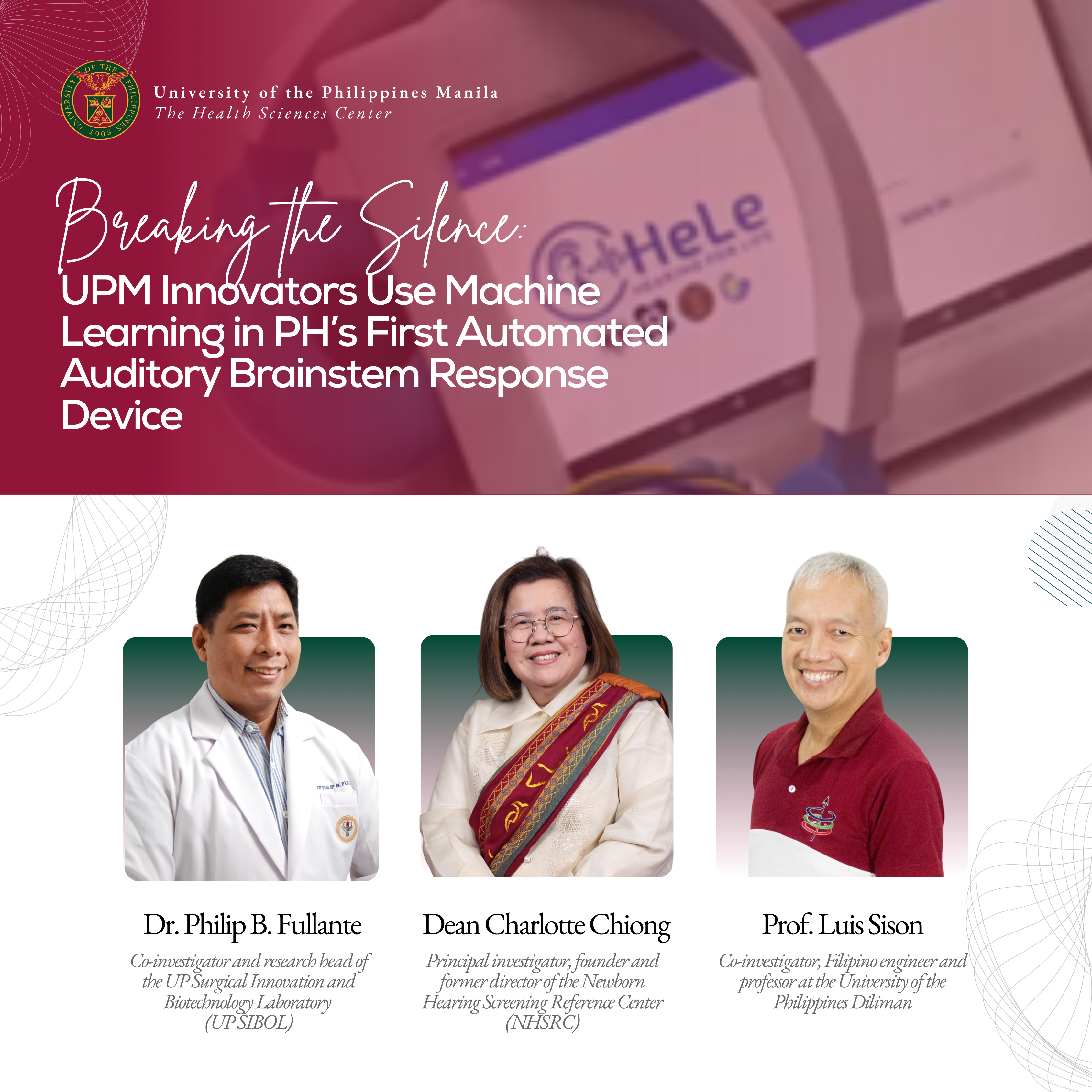
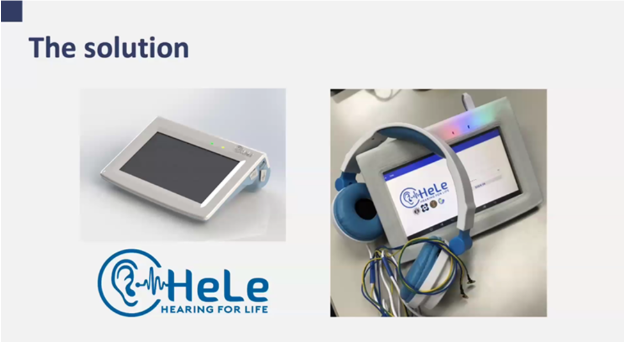
The sound of a lullaby is a universal symbol of a mother’s care. But for the eight Filipino babies born deaf every day, that melody, and the world of sound it represents, is often lost. With over 90% of hearing-impaired infants currently going undiagnosed (according to the Newborn Hearing Screening Reference Center), many miss the narrow window for early intervention. Now, a group of innovators from the University of the Philippines Manila is fighting to change that narrative. Their instrument is the HeLe (Hearing for Life): the nation’s first locally manufactured Automated Auditory Brainstem Response (AABR) device, powered by machine learning.
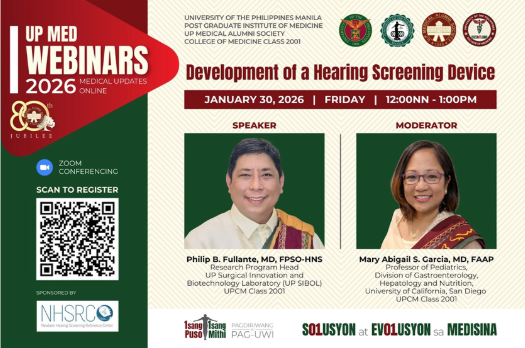
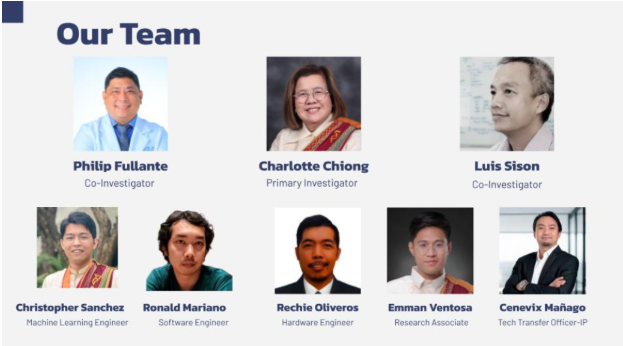
Dr. Philip B. Fullante, co-investigator and research head of the UP Surgical Innovation and Biotechnology Laboratory (UP SIBOL), recently showcased their innovative device during the UP Med Webinars 2026. For Dr. Fullante and principal investigator UP College of Medicine Dean Charlotte Chiong, founder and former director of the Newborn Hearing Screening Reference Center (NHSRC), the project is a direct response to a quiet national crisis. Beyond the staggering human cost, the NHSRC notes that untreated hearing loss imposes a P5.8 million burden per individual in specialized care and lost productivity. It is an expense the team describes as “highly avoidable,” provided diagnosis occurs within that critical developmental timeframe.
The decision to utilize AABR technology was deliberate. While simpler devices merely check the inner ear, the AABR remains the “clinical gold standard,” offering a comprehensive evaluation of the outer hair cells of the inner ear and neural pathways while employing a patented algorithm trained on a vast dataset of Filipino auditory waveforms, a localized precision calibrated to the neuro-auditory signatures of the Filipino population. This specific tuning allows the device to detect complex conditions, such as auditory neuropathy, that traditional tests frequently overlook.
The HeLe system functions as a neurological bridge, utilizing over-the-ear headphones to deliver acoustic stimuli that trigger the infant’s internal auditory circuitry. As sound travels, electrodes placed on the newborn’s head act as sensors, capturing the propagation of nerve impulses as they journey from the cochlea to the brainstem.
This biological feedback is recorded as voltage over time, creating a digital tracing that functions much like a neonatal “EKG for the ears.” These voltage peaks provide a signature of a child’s ability to process sound. By leveraging AI to analyze these tracings, the HeLe delivers an immediate “pass” or “refer” result. This automation removes the need for an on-site audiologist because of the Machine Learning Model that analyzes the results in real-time, a life-saving advantage in underserved rural areas where specialists are scarce.
A Future Beyond the Cradle
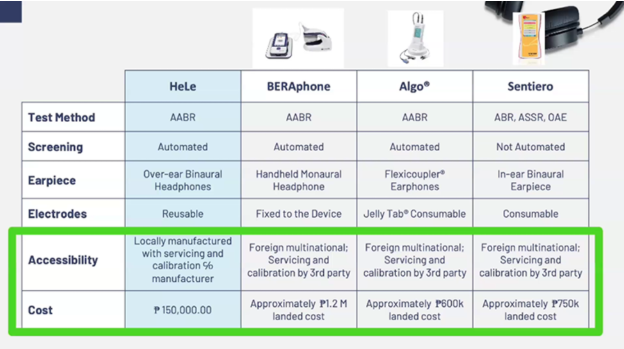
The HeLe marks a pivot in the Philippine medical landscape, transitioning the country from a mere consumer of expensive foreign tech to a manufacturer of high-end medical innovations.
Now at Technology Readiness Level 7 (TRL 7), the project has moved from laboratory concepts into early deployment, undergoing prototype demonstrations in real-world clinical environments.
The roadmap is as ambitious as the technology itself. Over the next few years, the project will scale toward full implementation across all Newborn Hearing Screening Centers (NHSC) nationwide. This rollout culminates in seamless interoperability with the Electronic National Newborn Hearing Screening Registry (ENNHSR), a move set to digitize and unify the country’s pediatric auditory data for the first time. Managed by the NHSRC, the ENNHSR is an electronic health information system for care documentation and referral management. It connects primary care and specialty care providers, a crucial component towards universal hearing health for the nation.
While hurdles in manufacturing and regulation remain, the team’s resolve is anchored in a future where geography and cost no longer dictate that a person born with a hearing disability can optimally engage with the world. For Dr. Fullante, the project is a testament to the untapped potential of local research and ingenuity. He believes that doctors have “a lot more opportunities not just in drug discovery, but also in…[developing] biomedical devices.”
The innovators of the HeLe nicknamed the project after the Filipino tender word for lullaby, Hele. It is their solemn hope that it “will ensure that no baby will grow up not hearing their parents’ loving voices,” Dr. Fullante affirms. It also emphasizes “the importance of hearing from birth for optimal development,” Dr. Chiong notes. Ultimately, the success of the HeLe will not be measured by patents or algorithmic precision, not even the return on investment to its industry partners, but by the silence it breaks in the most remote corners of the archipelago, for the most vulnerable children in need.
————–
For those interested in collaborating with or investing in this breakthrough, UP Manila encourages stakeholders to contact the TTBDO and/or IPPAO for further discussions.
Technology Transfer and Business Development Office (TTBDO)
2/F UP Manila Main Building, Joaquin Gonzales Compound,
Padre Faura Street, Ermita, Manila, Philippines
Email address: ttbdo.upm@up.edu.ph
Information, Publication, and Public Affairs Office (UP Manila-IPPAO)
Email address: upm-ippao@up.edu.ph
Author’s dedication:
To my beloved Ezraloukas—though your ears may not hear all tender whispers of mama and papa, we will speak our love in a language that only your heart can hear.
Read more:
#FP1 #FP6 #FP8 #AccessibleUPLeadership