
Text by Jennifer Manongdo
Photos by EGovMed Members
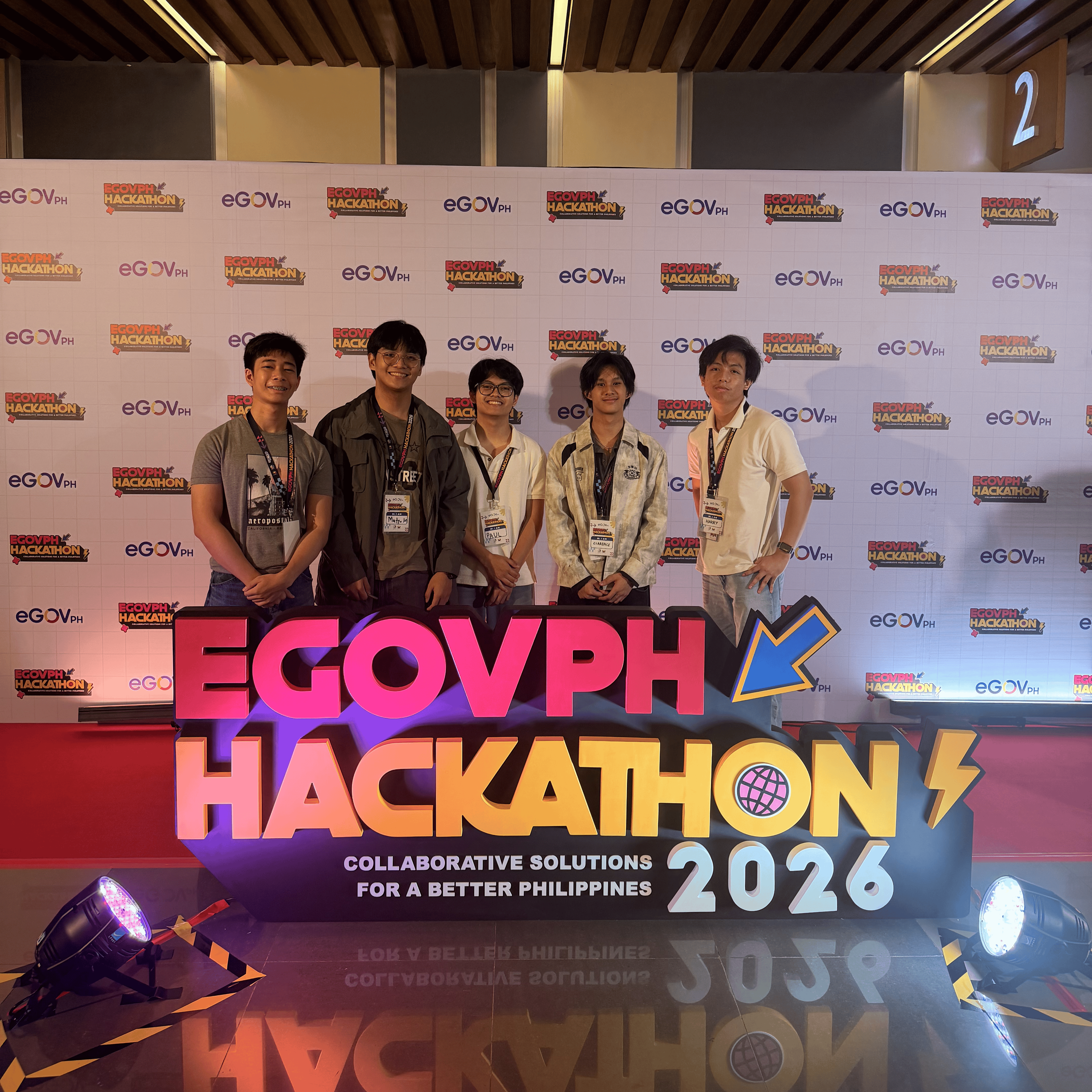
A five-person team composed of four BS Computer Science students from the University of the Philippines Manila and one from De La Salle University Taft has been named among the top 10 finalists of the 2026 eGov PH Hackathon.
Organized by the Department of Information and Communications Technology (DICT), the event ran from July 21- 22, 2026, in Taguig City and brought together student programmers and technology innovators to build digital solutions that would improve government service delivery and transactions in the Philippines.
Their project, eGovMed, aimed to improve systems on managing patient records and payment problems that slow down medical care in public hospital settings.
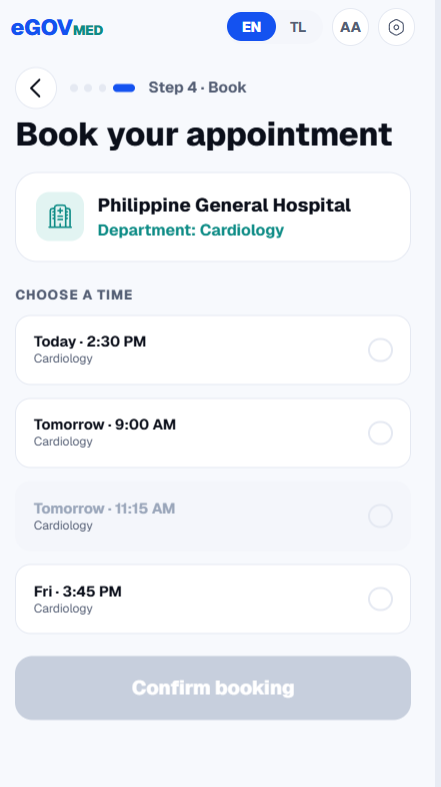
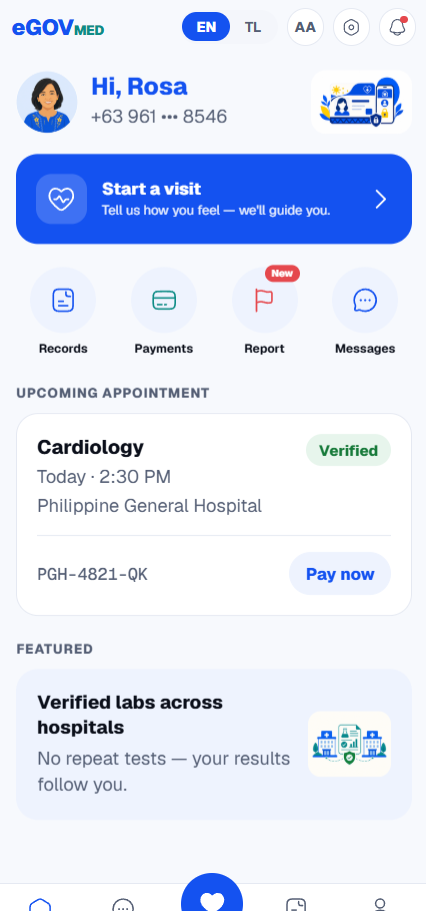
The eGovMed scheduling system
How eGovMed Works
Team Bisaya Hackers, composed of Matthew Labrador, Clarence Pagaduan, Paul Recio, Harry Gomez, and Javier Mendoza, built the project around a familiar scene at PGH: a mother arriving at 4 a.m. with a sick child, facing long queuing hours before finally receiving the right kind of care.
The team recalled moments that strengthened their resolve in developing a system that would end triaging woes. “We stood behind that desk and had to tell a mother she’d brought the wrong folder, or that a test she already paid for had to be repeated. eGovMed exists so the next family doesn’t hear that,” Labrador said.
Public hospitals like PGH often rely on front-desk staff or online portals to triage incoming patients. Patients are sometimes lost to follow-up because of mistyped phone numbers or email addresses. Others are made to repeat laboratory tests already on file elsewhere in the system, and some miss out on PhilHealth or “white card” assistance simply because no one walked them through the paperwork. PGH serves over 600,000 patients a year. In contrast, a 2025 study by Ateneo de Manila found that there are only eight doctors for every 10,000 Filipinos, still below the recommendation of the World Health Organization of 10 doctors per 10,000 population.
With eGovMed, there is no need to adopt new systems. It is built on top of eight existing government Application Programming Interface (API) to move a patient through the hospital system in a handful of automated steps: The patient logs in via eGovPH. By signing once, the eGovPH Single Sign On (SSO) logs the patient in and auto-fills their profile. Next, the eGov AI handles symptom triage, Tagalog translation, urgency flagging, and history summarization. This is followed by a National ID eVerify identity check with PhilSys, while Face liveness detection confirms the patient is a real person and not a fraudulent entry. Once verified and booked with the right healthcare provider, eMessage sends appointment confirmations and reminders through the patient’s phone number. During the medical visit, the doctor can access the patient’s AI summary, which shows all laboratory tests performed, including those completed in the patient’s province. The tests are marked as “verified.”
“This works through eGovChain, which anchors only a cryptographic proof, a hash or pointer, of her records on-chain. The patient’s actual medical data stays encrypted and private off-chain, in line with the Data Privacy Act of 2012; only proof of authenticity lives on the blockchain,” the student programmers explained.
“This is a deliberate design choice we want to emphasize: all of a patient’s records live digitally under a single verified identity. Labs, family history, and previous diagnoses aren’t scattered across paper folders and separate hospital systems. A doctor pulls up the patient’s name once, and everything relevant is already there, ready to be passed from one department or specialist to the next without the patient having to carry, explain, or re-produce any of it themselves,” they added.
After this, eGovPay prepares the bill and automatically applies the patient’s PhilHealth or white-card coverage. The remaining balance can be settled through GCash, credit card, or any supported channel. If something goes wrong, eReport tracks any unresolved issue by case number, automatically escalates it, and feeds the outcome back into the triage engine.
The Workflow
For the competition, the team shipped a working React web application backed by Node and FastAPI, centered on an LLM-driven triage engine. The live demo included real Tagalog-language symptom triage that produced structured specialty and urgency outputs, alongside a prototype of the verification, records, and payment flow.
The system’s backend was built to be client-agnostic, meaning it could plug into any hospital affiliated with the Department of Health.
Long-Term Plans
With eGovMed, the team knew that they had come up with the perfect solution to the problem. “The moment we stepped off stage, judges were already shaking our hands and telling us it was the best presentation they’d seen that day,” Gomez said.
The team’s longer-term plan is a lobby kiosk version of the same backend, aimed at walk-in patients who do not have a phone, an ID on hand, or a data plan, using in-session enrollment and an assisted mode.
“Same underlying system, one more way in for the people who need it most,” team Bisaya Hackers emphasized.
Read More:
#fp6 #DiscoveryandResearch