Hiraya 2026: Honoring Future Nurses Committed to Serving the Nation
Text by Charmaine A. LingdasPhotos by Sarah Hazel Moces S. Pulumbarit
Graduates of the UP Manila College of Nursing Class (UPCN) of 2026, Batch Hiraya, pose with faculty members following the recognition ceremony. Eighth from left is CN Dean Sheila Bonito, who led the college in honoring the graduates as they embark on their professional journey as IskoNars ng Bayan committed to compassionate service and advancing health for all.
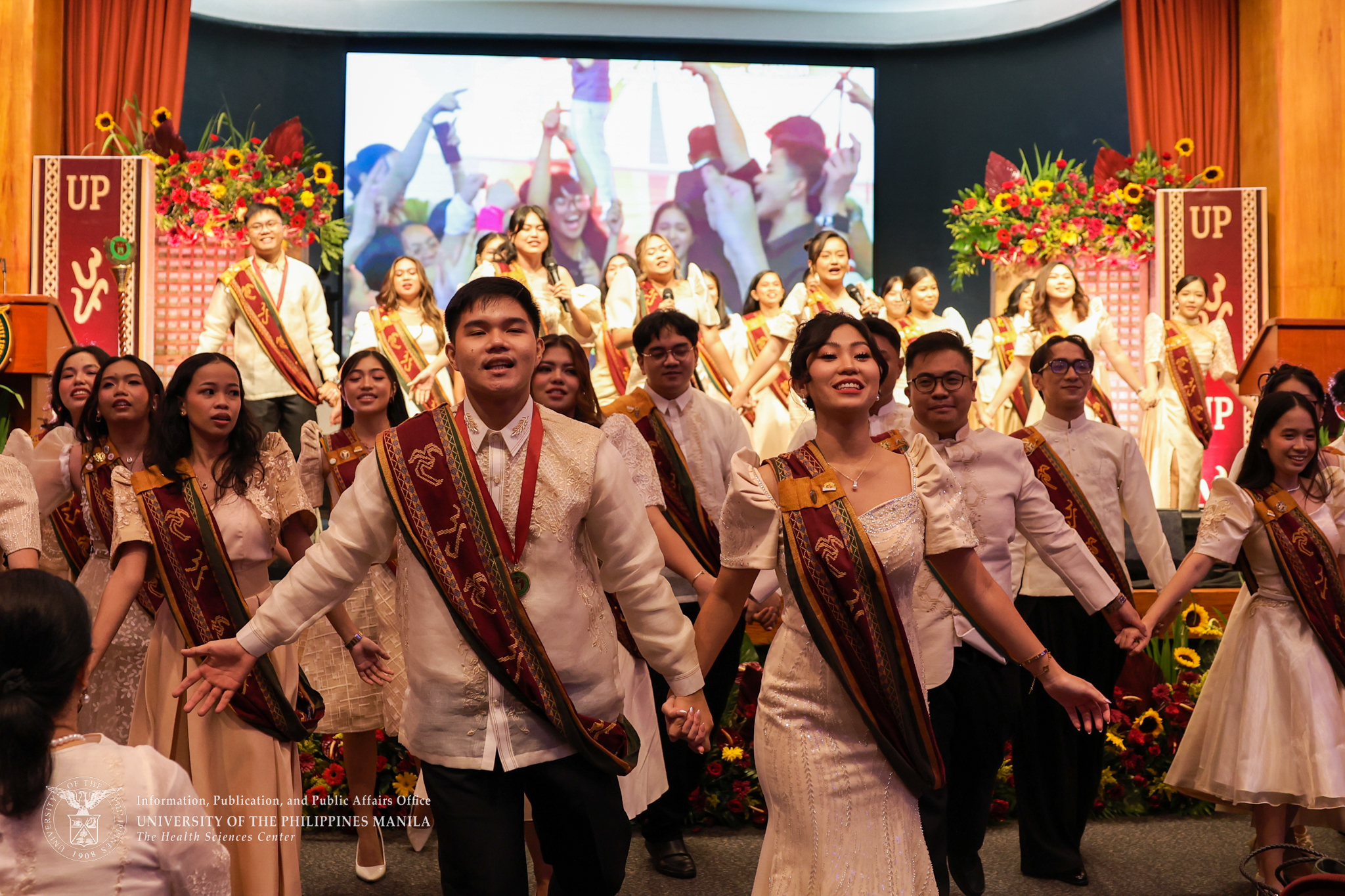
Amid the applause of proud families, the cheers of mentors, and the joy of celebrating years of perseverance, the University of the Philippines Manila College of Nursing (UPCN) reminded its graduating Class of 2026 that every honor bestowed upon them comes with an equally profound responsibility to uphold the highest standards of nursing. During its Araw ng Pagkilala held on Aug. 1, 2026, at the Philippine International Convention Center (PICC), carrying the theme "Hiraya: Pagpupugay sa Kalingang Alay sa Bayan," the recognition rites emphasized that earning a nursing degree marks the beginning of a lifelong commitment to serving the Filipino people with knowledge, skill, and compassion.
Hiraya, a Filipino word signifying aspirations and the realization of one's highest ideals, aptly reflected the graduates' journey through years of rigorous academic preparation to become not only future healthcare professionals but also "nurses of the nation," committed to compassionate and dedicated service.
The College recognized 77 graduates, comprising 66 Bachelor of Science in Nursing, six Master of Nursing Education, and five Master of Arts in Nursing graduates, all of whom completed the academic requirements for their respective degree programs.
UPCN Class of 2026 performs their batch graduation song, Hiraya, in a heartfelt tribute to the friendships, shared aspirations, and transformative journey that defined their years at the UP Manila College of Nursing.
Manus, Caput, et Cor
Dean Sheila R. Bonito urged the graduates to remain guided by the College's enduring philosophy of Manus, Caput, and Cor throughout their nursing careers. Manus calls on nurses to heal with skilled and compassionate hands; Caput fosters scientific thinking and a commitment to the common good; while Cor nurtures courage, empathy, and kindness. These qualities empower nurses to serve beyond what is expected of them.
Dean Sheila R. Bonito receives the UP Oblation Statuette in recognition of her outstanding leadership and distinguished service as Dean of the UP Manila College of Nursing from 2017 to 2026. The award honors her visionary leadership, unwavering commitment to academic excellence, faculty and student development, nursing scholarship, public service, and institutional growth, which strengthened the College and advanced its mission of educating nurse leaders in service of the Filipino people.
Congratulating Batch Hiraya for completing one of the University's most demanding professional programs, Dean Bonito encouraged the graduates to carry these values as they embark on their careers. "Nawa'y maging inspirasyon ang araw na ito upang lalo ninyong pag-ibayuhin ang inyong dedikasyon sa propesyon at ang inyong panata na maglingkod nang may kahusayan, integridad, at malasakit para sa kalusugan at kapakanan ng sambayanang Pilipino," she said.
Leading With Courage and Purpose in Nursing
Serving as keynote speaker was National President of the Philippine Nurses Association and UP Manila Doctor of Philosophy in Nursing alumnus Prof. Gian Carlo Torres. Introducing himself simply as "Nurse Gian," he reflected on how his doctoral education at UP Manila transformed his understanding of nursing beyond clinical practice, shaping him into a researcher, educator, and advocate for healthcare reform.
National President of the Philippine Nurses Association Gian Carlo Torres
Nurse Gian shared that although he found fulfillment as an operating room nurse and educator early in his career, pursuing doctoral studies at UP Manila challenged him to think more broadly about leadership, research, policy, and public service. The experience, he said, inspired him to take on greater responsibilities in advancing the nursing profession.
Drawing from his own journey, he encouraged the graduates to step beyond their comfort zones and embrace opportunities that foster growth, reminding them that meaningful leadership often begins with the willingness to face difficult challenges.
Recalling a message that stayed with him since his own graduation—"In times of crisis, the line of fire is a place of honor"—Nurse Gian urged the graduates to meet uncertainty with courage, noting that nurses are often called to serve where they are needed most.
He also acknowledged the realities facing the nursing profession, including workforce shortages, unsafe nurse-to-patient ratios, inadequate compensation, and the limited availability of plantilla positions. Despite these challenges, he emphasized that Filipino nurses continue to uphold their commitment to care through their daily acts of service.
"May mga pagkakataong mararamdaman natin na hindi sapat ang ating sarili. Hindi sapat ang suporta. O hindi sapat ang kompensasyong nakukuha natin. Ngunit sa kabila ng lahat ng ito, araw-araw pa rin nating pinipiling pumasok. Araw-araw pa rin nating pinipiling maglingkod. Pinipili pa rin nating mag-alaga. At ang pagpiling iyon araw-araw sa kabila ng lahat, ang tunay na sukatan ng ating dedikasyon bilang isang nurse," Nurse Gian said.
Recognizing Excellence in Scholarship, Leadership, And Service
Beyond honoring academic achievement, the College of Nursing recognized graduates who distinguished themselves through leadership, scholarship, clinical excellence, and service to both the University and the community.
Graduates who demonstrated outstanding academic achievement, leadership, clinical excellence, community involvement, and service receive special awards and scholarship grants during the UP Manila College of Nursing Recognition Ceremony for the Class of 2026.
Austine Dave Pareja received the Community Involvement Award for his active engagement and meaningful contributions to community initiatives. He was also conferred the Best in Clinical Performance Award, recognizing his outstanding performance in both hospital- and community-based nursing practice.
The highest academic distinction was awarded to Kynier Fababier, who was named Unang Dangal ng Hiraya (Class Valedictorian) and received the Bienvenido Gonzales Award, the College's highest honor for academic excellence.
Austine Dave Pareja and Kynier Fababier
A Valedictorian's Call to Lead with Purpose
Fababier delivered the valedictory address on behalf of the graduating class, reflecting on the collective journey of Batch Hiraya and the patients, communities, and fellow nurses who shaped their education. Looking back on years of rigorous coursework, clinical training, and community immersion, he honored the resilience, sacrifices, and shared aspirations that carried the class to graduation. He emphasized that their greatest lessons came not only from classrooms and hospitals but also from the people whose stories deepened their understanding of health, dignity, and service.
Fababier reminded his fellow graduates that the true measure of their work would not be defined by awards or recognition, but by the trust they earn and the compassion they extend to those they serve.
“Ang halaga ng ating ginagawa ay hindi lamang nasusukat sa katiyakan ng pagbabagong ating maidudulot. Makikita rin ito sa bawat tiwalang naipagkakaloob, dignidad na napangangalagaan, at ginhawang naibibigay ng isang makataong pagkalinga.”
He also recalled the words of their community organizer in Cavite, which became a guiding principle throughout his address:
“Hope is not knowing that things will get better. It is finding something worth fighting for, even when you do not know if the change will happen in your lifetime.”
Kynier Fababier
Calling on his fellow graduates to remain true to their calling as IskoNars ng Bayan, Fababier challenged them to look beyond bedside care and help build a more just healthcare system.
“Sapagkat ang tungkulin ng isang IskoNars ng Bayan ay hindi lamang tumugon sa sakit, kundi makiisa sa pagbuo ng mga kondisyong nagbibigay-daan sa makatarungang kalusugan.”
Looking Back with Gratitude
Representing the graduating class, Lynze Kyle Fernandez delivered the retrospective speech, taking classmates and guests on a heartfelt journey through Batch Hiraya's years in the College.
Lynze Kyle Fernandez
With stories that resonated with both laughter and nostalgia, Fernandez recalled the countless hours spent mastering clinical skills, navigating examinations, supporting one another through challenges, and discovering the profound meaning of caring for patients and communities. The retrospective celebrated not only academic milestones but also the relationships and experiences that transformed a group of students into future colleagues united by a common mission.
Fernandez expressed gratitude to the faculty members, staff, families, friends, and loved ones whose encouragement sustained the graduates throughout their journey, emphasizing that every success achieved by Batch Hiraya was made possible through a community that believed in them.
A New Chapter Begins
Asst. Prof. John Joseph Posadas, adviser of Hiraya: UPCN Class of 2026, encouraged the graduates to carry forward the values and traditions they cultivated in the University as they embark on the next stage of their professional lives.
Asst. Prof. John Joseph Posadas, adviser of Hiraya: UPCN Class of 2026
He reminded the graduates that while the recognition rites marked the culmination of their academic journey, they also signified the beginning of a greater calling—one that demands lifelong learning, humility, and an enduring commitment to serving others.
For the graduates of Batch Hiraya, the ceremony was more than a celebration of academic achievement. It was a reaffirmation of the ideals that define UP nursing: that knowledge must be matched with compassion, excellence with integrity, and every act of care with a steadfast commitment to the Filipino people.
READ MORE:
https://www.upm.edu.ph/cpt_news/upcn-honors-class-of-2025-in-recognition-rites-celebrating-courage-grit-honor-and-excellence/