

Text and photo by the Department of Social Sciences
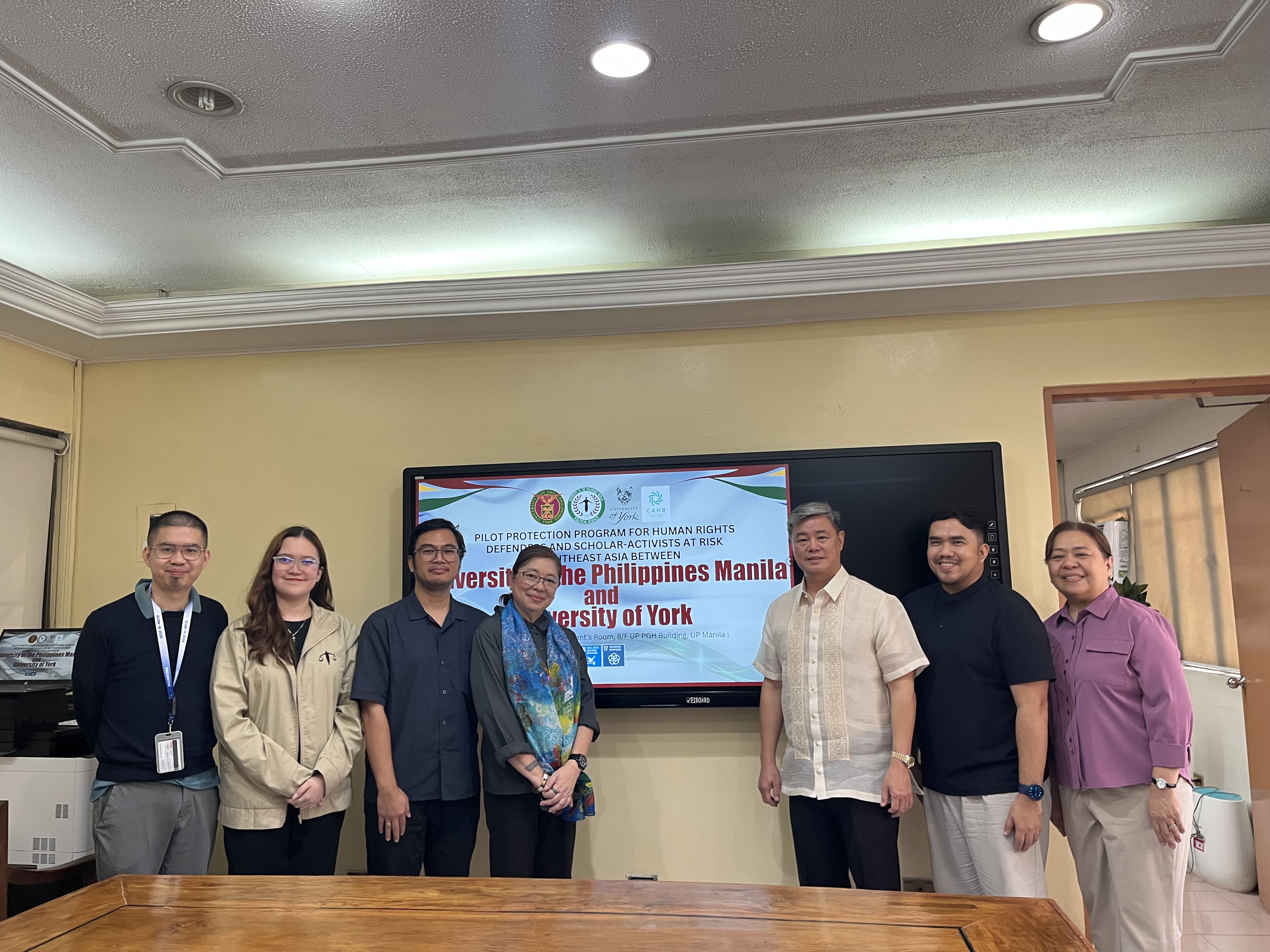
The University of the Philippines Manila (UP Manila), through the Political Science Program of the Department of Social Sciences (DSS), College of Arts and Sciences (CAS), and the Centre for Applied Human Rights (CAHR) of the University of York, launched the Pilot Protection Program for At-Risk Human Rights Defenders and Scholar-Activists in Southeast Asia on September 15, 2026.
The initiative establishes a framework for collaboration between UP Manila and the University of York to provide institutional support and temporary protective spaces for human rights defenders and scholar-activists whose work and safety are at risk.
The formal launch was attended by UP Manila Chancellor Michael L. Tee, CAS Dean Ma. Teresa G. De Guzman, DSS Chairperson Wensley M. Reyes, and Political Science Program Coordinator Clarinda L. Berja, along with Professors Jose Mikhail F. Perez, Beatrice A. Fernandez, and Carl Marc L. Ramota, who serves as project coordinator. Prof. Paul Gready, UNESCO Chair in the Protection of Human Rights Defenders and Expansion of Political Space and Director of CAHR, and Dr. Bencharat Chua, Director of the Southeast Coalition for Academic Freedom (SEACAF), conveyed their support for the initiative through recorded messages.
Strengthening Institutional Protection
The pilot program is among efforts to strengthen the capacity of higher education institutions to uphold academic freedom, protect human rights defenders, and contribute to the expansion of democratic space in Southeast Asia. It is envisioned as a first-of-its-kind initiative in the region that positions universities as potential temporary spaces of protection for individuals facing threats because of their human rights and academic work.
Human rights defenders across Asia and Southeast Asia continue to face various forms of threats, including harassment, intimidation, surveillance, vilification, arbitrary detention, imprisonment, and politically motivated legal actions. Those working on environmental protection, press freedom, gender equality, minority rights, labor rights, and other human rights concerns are among those who may be exposed to such risks. Members of the academic community – including faculty members, researchers, students, and scholars – may likewise face threats for exercising academic freedom, conducting research on politically sensitive issues, participating in public discourse, or advocating for human rights and social justice.
These challenges underscore the need for institutions that can provide meaningful forms of protection and support. In this context, universities have a distinct role as spaces for knowledge production, critical inquiry, and public engagement, as well as institutions that can contribute to the protection of individuals and communities facing repression. The pilot program seeks to provide at-risk human rights defenders and scholar-activists with opportunities to temporarily access a safe and supportive academic environment.
These may include opportunities for rest and recovery, academic and professional engagement, skills development, knowledge exchange, and networking with human rights defenders and academic communities across the region. The initiative also aims to strengthen transnational networks and facilitate the sharing of experiences and strategies among human rights defenders, scholars, and institutions working to protect human rights and academic freedom.
Advancing academic freedom and human rights
For UP Manila, the initiative builds on the University’s continuing efforts to institutionalize mechanisms for the promotion and protection of academic freedom and human rights. In 2024, UP Manila established the Committee on the Promotion and Protection of Academic Freedom and Human Rights (CAFHR) as a university-based mechanism dedicated to monitoring and responding to concerns involving violations of academic freedom and human rights. The establishment of CAFHR reflects UP Manila’s commitment to fostering an academic environment where members of the University community can pursue teaching, research, public engagement, and other forms of scholarly work with respect for academic freedom and human rights. The partnership with the University of York further expands this institutional commitment by connecting UP Manila with a broader regional network concerned with the protection of human rights defenders and the preservation of democratic and academic spaces.
Through the pilot protection program, UP Manila and its partner institutions seek to contribute to the development of higher education institutions that are responsive to threats against academic freedom and human rights and that recognize the protection of human rights defenders as an integral component of their institutional mission. The initiative ultimately seeks to strengthen the role of universities as human rights-based institutions that uphold academic freedom, promote democratic participation, and provide meaningful institutional support to individuals whose work advances human rights and the public interest.
#FP1 #AccessibleUPLeadership
Read More: