
Text by Cherry Madrideo
Photos by Erlyn Pareja and Joseph Bautista
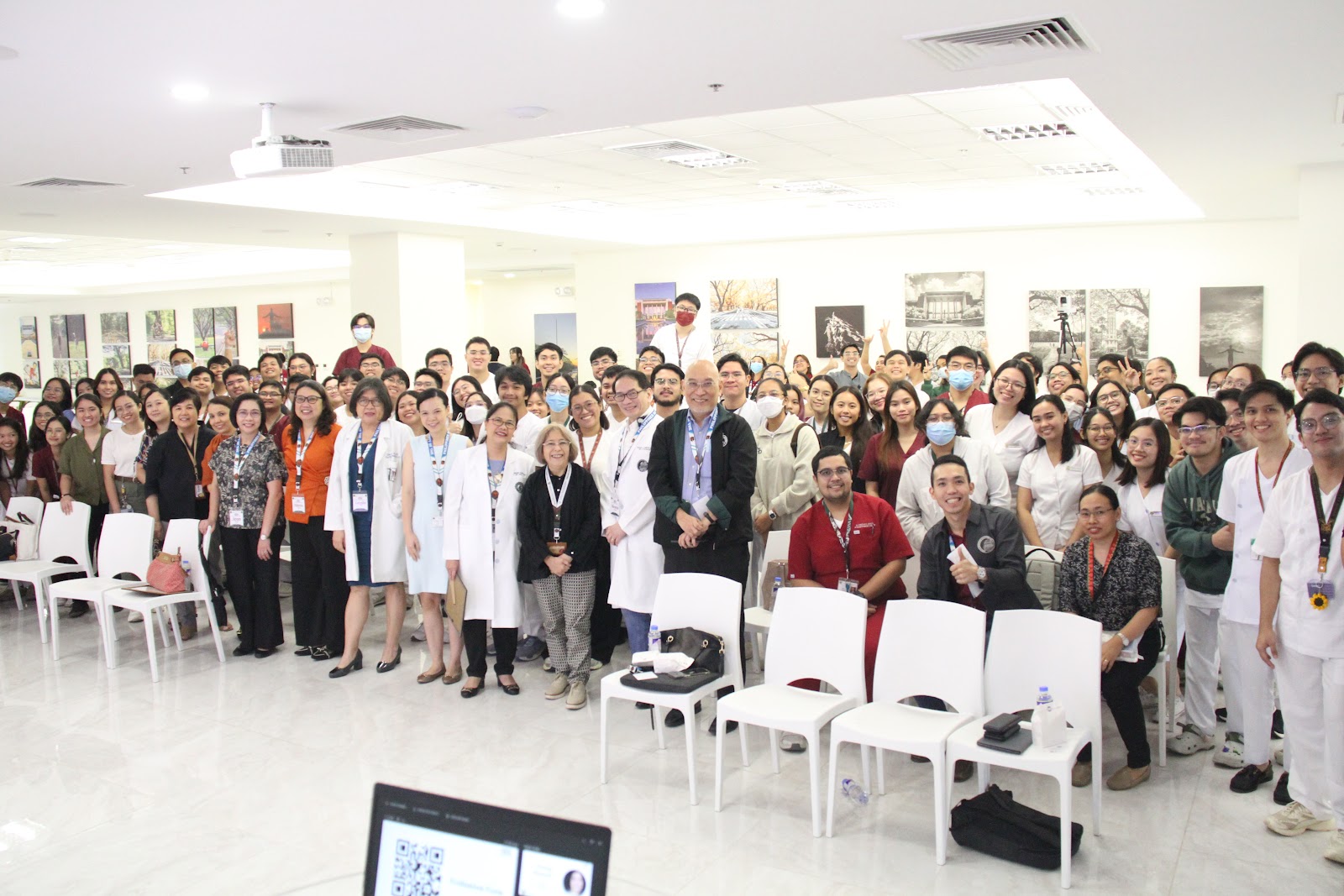
The speakers and participants of the morning session hosted by the College of Medicine and the Philippine General Hospital.
A powerhouse of lectures ignited day 2 of the UP Manila Science and Technology Week’s “Siyensya, Teknolohiya at Inobasyon: Kabalikat sa Kalusugang Pangkalahatan.” The celebration was hosted by the College of Medicine (CM) and the Philippine General Hospital (PGH) in the morning and the College of Pharmacy (CP), College of Allied Medical Professions (CAMP), and National Teacher Training Center for the Health Professions (NTTCHP) in the afternoon of November 19 at the Henry Sy Sr. Building.
CM and PGH
 |  |
Dean Charlotte Chiong and PGH Director Gerardo Legaspi offered their insights on the “Strategies and Initiatives in the Delivery of Healthcare in Medical Education in Support of Universal Healthcare”
CM Dean Charlotte Chiong presented the subtheme, “Strategies and Initiatives in the Delivery of Healthcare in Medical Education in Support of Universal Healthcare,” which serves as the anchor for the morning session’s topics. She noted that the college’s research initiatives aim to address gaps in access, quality, and affordability of healthcare services. She encouraged research to be published in the Acta Medica Philippina journal, as it is now indexed in PubMed Central.
Department of Clinical Epidemiology Assoc. Prof. Carol Stephanie Tan-Lim examined the impact of primary care system interventions on healthcare worker satisfaction and its broader implications in her topic, “Impact of Primary Care System Interventions in Healthcare Worker Satisfaction and Intention to Stay in the Philippines: A Follow-up Study.” Dr. Alvin Marcelo of the Medical Informatics Unit focused on the integration of geographic information systems (GIS) in health information systems for equitable service delivery and stressed that “granular data” is essential in monitoring equitable service delivery, requiring geo-enabled systems in his talk on “The Geography of Universal Health Coverage: Why Geographic Information Systems are Needed to Ensure Equitable Access to Quality Health Care.” Department of Pediatrics Professor Leonila Dans shared that strengthened primary care led to significant increases in healthcare utilization: 200% increase in rural areas, 350% in remote areas after one year, but inequities persisted, with remote areas still facing greater out-of-pocket expenses as she explored on her topic, “Health Benefit Utilization and Out-of-Pocket Expenses in Outpatient Care and Hospitalizations: Baseline Surveys 3 Primary Care Sites.” She highlighted primary care as the foundation for achieving UHC and addressing inequities in healthcare access.
Dr. Brent Andrew Viray, a fellow at the Department of Surgery, discussed “Strengthening Rural Surgery in the Philippines: Essential in Achieving Universal Health Care” and pointed out that access to surgical care is a significant gap in public health, particularly in rural areas of the Philippines, and prioritizing rural surgery through policy, training, decentralization, and community engagement is essential to achieving universal healthcare. Collaborative efforts between government, local leaders, and healthcare providers are vital to bridging the inequities in surgical access and improving outcomes for underserved populations. Dr. Aileen Espina, coordinator for External Linkages and Universal Health Care head of the PGH, stressed in “UP PGH Preparations for UHC” that the PGH is uniquely positioned to lead the transition to an integrated, UHC-aligned healthcare system while maintaining its role as an apex hospital. Through innovative programs, partnerships, and strengthened training for primary care, PGH aims to address systemic gaps, ensuring health professionals are equipped to meet the needs of the Filipino population. Finally, “UPCM Preparations for Universal Healthcare” was discussed by Assistant Associate Dean for Academic Development Agnes Soriano-Estrella. The UHC Act mandates a paradigm shift in healthcare delivery and medical education in the Philippines, and the UPCM is at the forefront of this transformation, revising its curriculum to prepare future physicians as primary care-ready professionals. By 2030, these efforts aim to create a healthcare system that ensures equitable, quality care for all Filipinos, setting a national standard for medical education reform.
A panel discussion, composed of all the speakers, was held as the culminating activity for the morning sessions.
PGH Director Gerardo Legaspi reflected on a graduate who excelled academically in surgery but needed practical knowledge about working in provincial hospitals, such as understanding level 2 hospital operations or health information systems. This gap reinforced the importance of integrating practical health system knowledge into medical education. He noted that Universal Health Care (UHC) is unavoidable and essential for the health system; its implementation remains a challenge, and understanding it must begin during medical education to ensure students gain comprehensive knowledge.
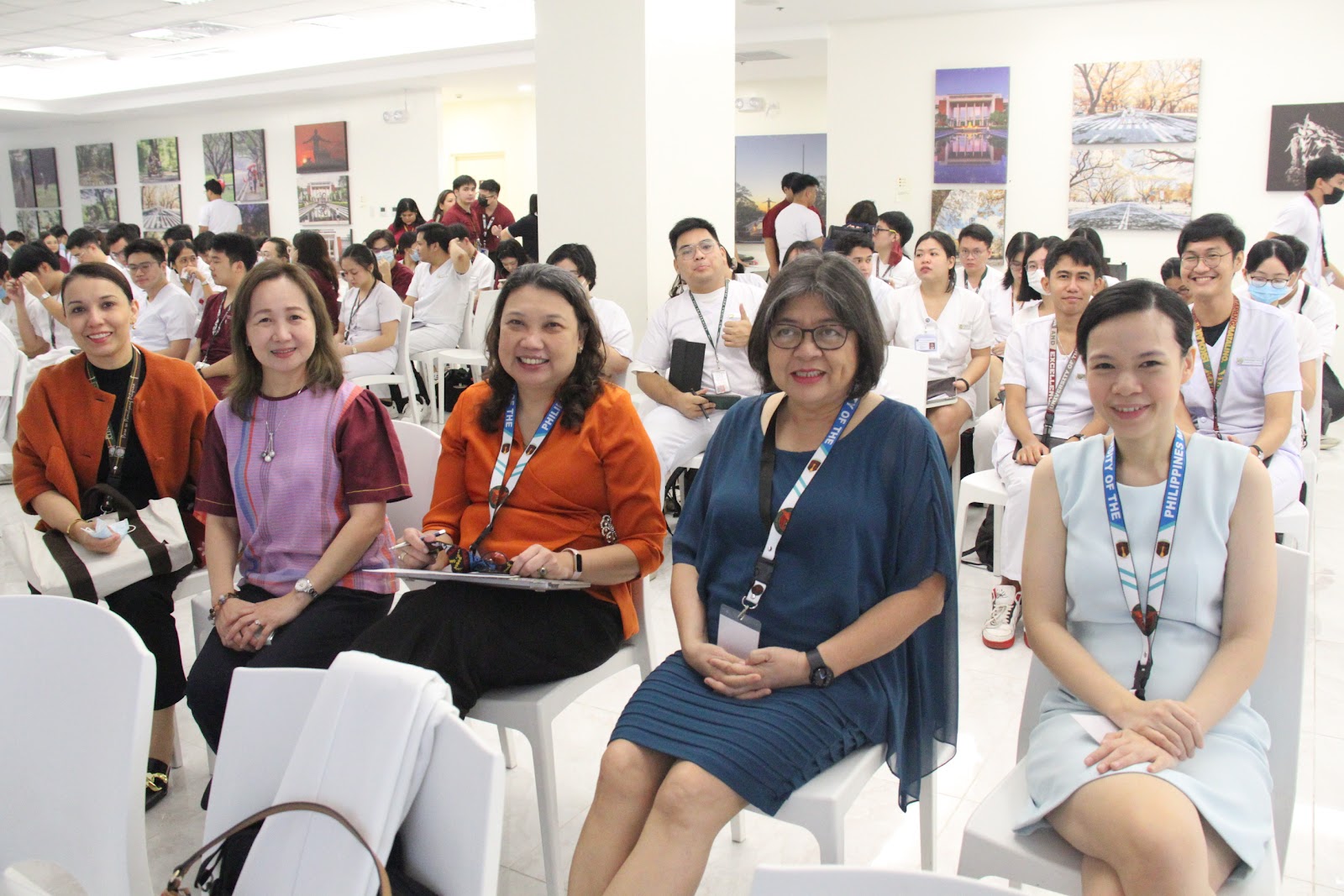
Dr. Leslie Dalmacio, head of the Office of the Vice Chancellor of Research, joined the speakers at the celebration facilitated by her office.
CAMP, CP, and NTTCHP
 |  |
CAMP Dean Esmerita Roceles Rotor and NTTCHP Dean Maria Elizabeth Grageda introduced the afternoon session subthemed, “Health Professions Education, Pharmacy, and Allied Medical Professions: Responding to the 21st Century Changing Health Landscape and Contributing to Universal Health Care.”
CAMP Dean Esmerita Roceles Rotor shared the subtheme, “Health Professions Education, Pharmacy, and Allied Medical Professions: Responding to the 21st Century Changing Health Landscape and Contributing to Universal Health Care,” and noted that the afternoon topics were rooted in the health needs of the Filipinos: evidence-driven and transformative allied health education, responsive and capable professionals, Filipino-centric and quality service, and healthy and resilient Filipinos. Prof. Erlyn Sana highlighted the NTTCHP’s role in preparing health professionals to become effective teachers. The topic presentation of NTTCHP revolved around capacitating health profession education and institutions.
“Self-Directed Learning of Preclinical Medical Students in Basic Surgical Skills Through Remote Teaching” was discussed by Dr. Karlos Noel Aleta, where he concluded that it was possible to teach preclinical students’ basic surgical skills on an online platform at their own pace via self-directed learning. Given the proper motivation and instructional design, this can be made part of the Surgery curriculum and arm the learner with the proper skills needed when they reach their clinical rotation proper.
“Development of a Transformative Model of Change to Future Proof Mental Health Education, Research, and Service in the Department of Psychiatry and Behavioral Medicine” by Dr. Evangeline Dela Fuente, associate professor and chair of the Department of Psychiatry and Behavioral Medicine. She stressed that effective change management for future-proofing is possible and the need for change is accepted when the following factors are properly presented: clarity of task demands, a supportive environment, and psychological safety. Likewise, the process had to be iterative for the change to take hold and to avoid reverting to the previous behavior. This would enable members to responsibly address the evolving mental health needs of the Filipino people with honor, excellence and service.
“Current Landscape of Maternal and Child Health Referral System in Eastern Visayas Region: Systems Analysis and Policy Recommendations” was by Asst. Prof. Frederick Nieto of NTTCHP. He presented the challenges in the capacity building and services of the local health referral system and the policy and program recommendations to improve the system. Collaboration with the local government unit (LGU), strengthened health human resource, investment in the information and communication technology (ICT), infrastructure and equipment are needed to maximize the health care service delivery.
Department of Speech Pathology Asst. Prof. Bernice Alecsa Austria delivered “Quantifying the Costs of Communication Disorders in Children Ages 3-6 Years Old” where she discussed that with our country’s fragile healthcare system, the increase in physician visits and hospital days has led to the economic burden of families with children with speech/ language disorders increasing. In response to the current gap, their group created a survey tool to economically evaluate the direct and indirect costs of communication disorder interventions to create data on a national level. She will share the final results of the study once they are available.
Department of Physical Therapy Asst. Prof. John Patrick Lentejas discussed “Association of First-Trimester Screening Biomarkers and the Prevalence of Cerebral Palsy and Other Neurodevelopmental Conditions: A Systematic Review,” where he stated that poor perinatal and antenatal care factors can affect the chances of developing neurodevelopmental conditions. More studies are needed to further identify the relationships between first trimester screening (FTS) and infants at risk of specific neurodevelopmental problems and more research on the association of the markers to other neurodevelopmental conditions.
Department of Physical Therapy Prof. Maria Eliza Aguila presented “Translating Innovation from Concept to Clinic in the Rehabilitation of Cerebral Palsy and Dementia Using Immersive Gamification Technology,” where she discussed the concept, development process, and clinical applications of Axel Virtual Care immersive gamification and virtual reality for personalized, engaging, and inclusive rehabilitation for cerebral palsy and dementia. Axel’s testing revealed high usability, safety, and engagement, and its ongoing refinements are focused on aligning the system with user needs.
Pharmacy licensure exams recent passers—Gabrielle Dae Ocampo, Gem Edine Lee, and Sara Abigail Tiu—presented their best thesis award, “Fabrication and Qualification of a 3D Printed Lab-scale Powder Blender.” The group was able to fabricate a 3D printed powder blender, capable of dry powder blending, which passed the design, installation, operational, and performance qualifications. The blender is a relatively cheaper piece of equipment, and it also addresses potential sources of variation when it comes to the production of solid dosage forms. The study hopes to open avenues for other similar research and help in the improvement of delivering quality healthcare.
Sean Paul Rojo, Jude Acedera, and Jary Soriano introduced their thesis on the “Development and Evaluation of a QR-coded Drug-loaded Orodispersible Film Using 2D Inkjet Technology.” The thesis was recognized as one of the best thesis presentations of the 2nd Pharmaceutical Thesis defense held last June 2024. It aims to address the challenges faced by vulnerable populations in taking traditional tablets and capsules by developing an orodispersible film that provides a more convenient and compliance-friendly alternative for patients managing their medications.
Finally, Jarvin Enosh Tan delivered “A Pilot Randomized Controlled Trial of an Unguided Self-help CBTi Intervention for Insomnia in Young Filipino Students,” where he underscored the potential of accessible, evidence-based interventions for insomnia in the Philippines. Tan, however, saw the need for more trials with enhanced recruitment strategies and culturally sensitive adaptations necessary to provide conclusive evidence.
NTCCHP Prof. Nemuel Fajutagana, NTCCHP Dean Maria Elizabeth Grageda, CAMP Assoc. Prof. Aila Nica Bandong, and Pharmaceutical Chemistry Chairperson Joanna Orejola served as reactors.
College of Pharmacy Dean Francis Capule, in his closing remarks, encouraged everyone to continue to champion the cause of universal healthcare in their respective capacities, and together we have the power to create a healthier, more inclusive world where access to quality healthcare is a fundamental right for all.