
Text by: Charmaine Lingdas
Photos by: Sarah Hazel Moces Pulumbarit

“Health services remain one of the most concrete expressions of social justice… When public institutions work, suffering is reduced and life is extended. When they falter, the burden shifts immediately to patients, families, and front-line workers,” Mamamayang Liberal Party-list Rep. Leila De Lima, a social justice and human rights champion, told graduating residents and fellows of the Philippine General Hospital (PGH) during their Commencement Exercises 2025 on Jan. 6, 2026, at the St. Paul Fleur-de-lis Theater.

Addressing the 390 physicians trained at the country’s national university hospital, De Lima stressed that “many Filipinos postpone healthcare because of cost,” while others “arrive at hospitals when illness has already progressed, carrying fear that treatment will also mean debt.” She emphasized that healthcare outcomes in the Philippines depend not only on clinical skill, but also on systems and policy choices.

She emphasized that hospitals like PGH are strained by demands that do not align with their mission, realities the graduates have seen in long patient waits, families unable to afford tests, delayed cancer care, and the steady loss of personnel from public hospitals. She added that these conditions reflect how decisions made in Congress translate directly into the realities on the ground, particularly when the health budget becomes an afterthought.

In 2021, De Lima expressed concern over the persistent delays by the Philippines Health Insurance Corporation (PhilHealth) and the Department of Health in releasing payments to accredited hospitals and healthcare workers. Meanwhile, PGH has improved its services and access over the years but it continues to face a sustained influx of patients that strains its capacity.
In the event, De Lima pointed out that “while compassion has its place,” she emphasized that “social justice is built when people can rely on systems, when services are delivered consistently, when public money is protected, and when the state fulfills its duties rather than distributing privileges.”

Lighting the path of public healthcare
Citing the commencement theme “Tanglaw: Liwanag ng Pag-asa at Pagbabago,” De Lima said that tanglaw (light) in PGH is visible, in emergency rooms operating under pressure to charity wards carrying more patients than they were designed for, as well as in specialists and trainees committed to reliable, high-quality care. She described PGH as “more than a hospital, where Filipinos, regardless of wealth or status, deserve competent care, serious attention, and dignity in illness.” According to De Lima, the hospital trains physicians to understand the realities of the country, including “advanced disease, delayed care, poverty, resilience, and hope.”
She urged the graduates to recognize their responsibility beyond the bedside, saying their training has given them the authority on public healthcare needs. “Your voice carries authority because it comes from lived experience,” she said, particularly when calling for reforms in strengthening public hospitals.
“Light, in this sense, requires more than compassion. It requires institutions that are defended, resourced, and strengthened. It requires professionals who understand how policy and practice meet, and who are willing to speak with authority about what public healthcare truly needs,” she said, adding that the same tanglaw means holding together healing and justice.

Leadership Roles

PGH Deputy Director for Health Operations Dr. Regina Berba said the graduates are now poised to take on leadership roles in Philippine healthcare. As a parting gift to graduates, PGH Director Dr. Gerardo Legaspi shared a meaningful quote from Mahatma Gandhi, who said, “become the change that we want to be, and as we imagine these things, we have to be, of course, prepared in carrying them out, and be determined in continuing to think of ways on how to achieve this.”
Dr. Legaspi likened the transition from being a trainee to a full-fledged physician to learning how to ride a bicycle, noting that the institution is now letting go as they move forward independently. “Today, we let go of that bicycle seat. And you are in the best form and the best skills to keep pedaling on, moving forward, and riding into the dreams that you have, and imagining a world that you ride into from here on. So today, I’d like to ride that bike with you, not from behind, but on your side, as we imagine a better world for everyone,” he said.

Highlighting the role of UP-trained physicians, College of Medicine Dean Charlotte Chiong said, “The UP College of Medicine and the Philippine General Hospital do not simply produce specialists. It produces physician leaders.” She noted that while more than 80 state universities and colleges now have medical schools, these institutions need more than a curriculum. “They will need medical educators, mentors, and institutional builders,” roles she said PGH graduates are prepared to fill.

Listening to Patients

Chancellor Michael Tee cautioned the young doctors that “transparency can be buried in the opacity of ignorance.” To avoid this, he stressed the importance of listening in medical practice. “Like a patient whose symptoms are obvious but whose illness remains undiagnosed, truth can remain in plain sight. Hidden. Transparency can be buried in the opacity of ignorance,” he said. “It takes an educated medical professional to shed light, interpret what is seen, and give it meaning.”

Dr. Allynna-Haneefa Macapado-Said delivered the message on behalf of the graduates. She thanked PGH for preparing them for the realities of the profession.
“Our hope is that one day, no Filipino patient will be left behind… Wherever our paths may take us, we carry with us the responsibility that PGH instilled,” she said.
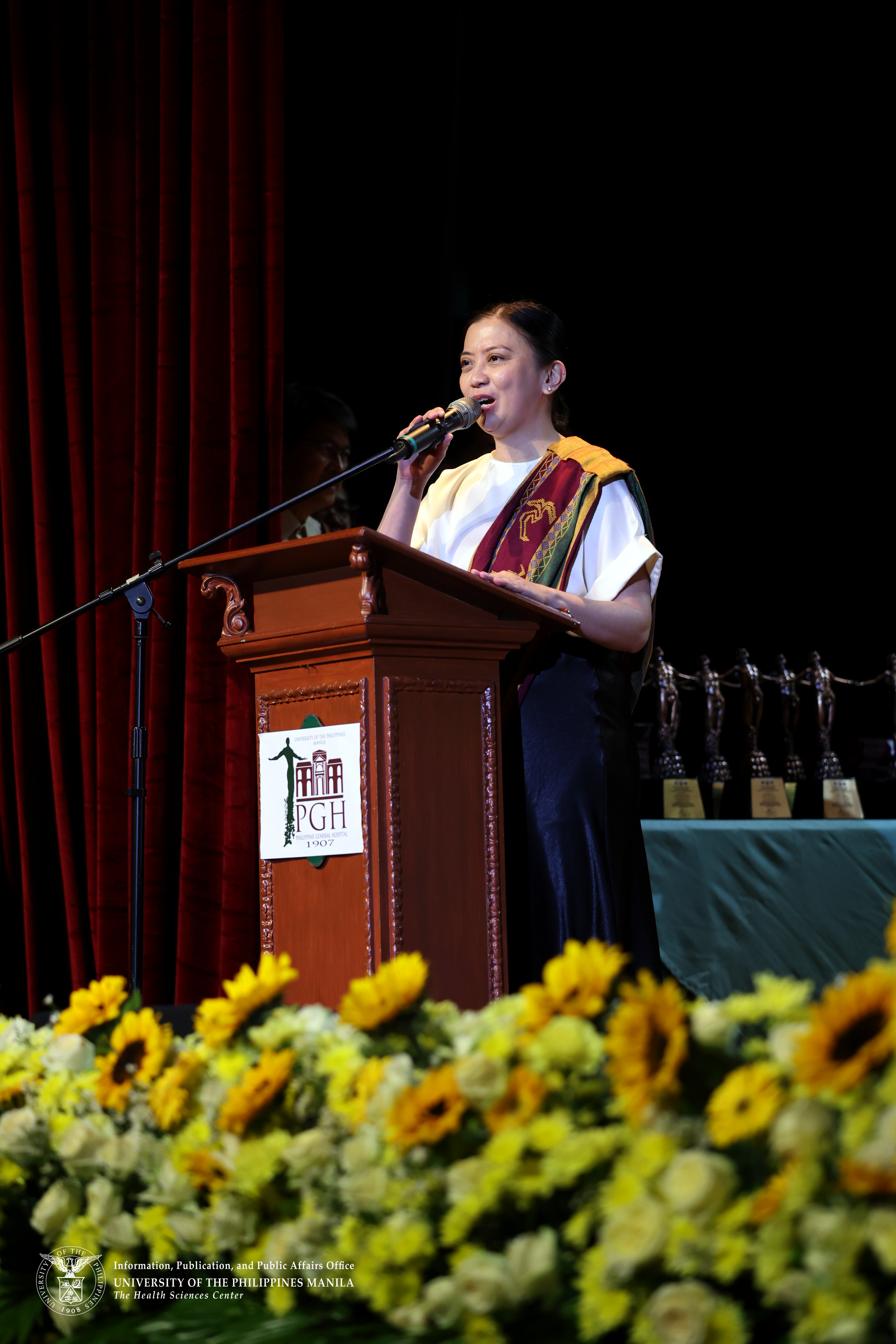
Before the end of the ceremony, Dr. Marie Dionne Sacdalan, training coordinator from the office of the Deputy Director for Health Operations urged the graduates to remain grounded in the values formed at PGH. “Service, Professionalism, Integrity, Compassion, and Excellence—these values will be your compass,” she said.





Read More:
#FP1 #FP6
#AccessibleUPLeadership