
Text by Martin R. Racza
Photo by Joseph A. Bautista
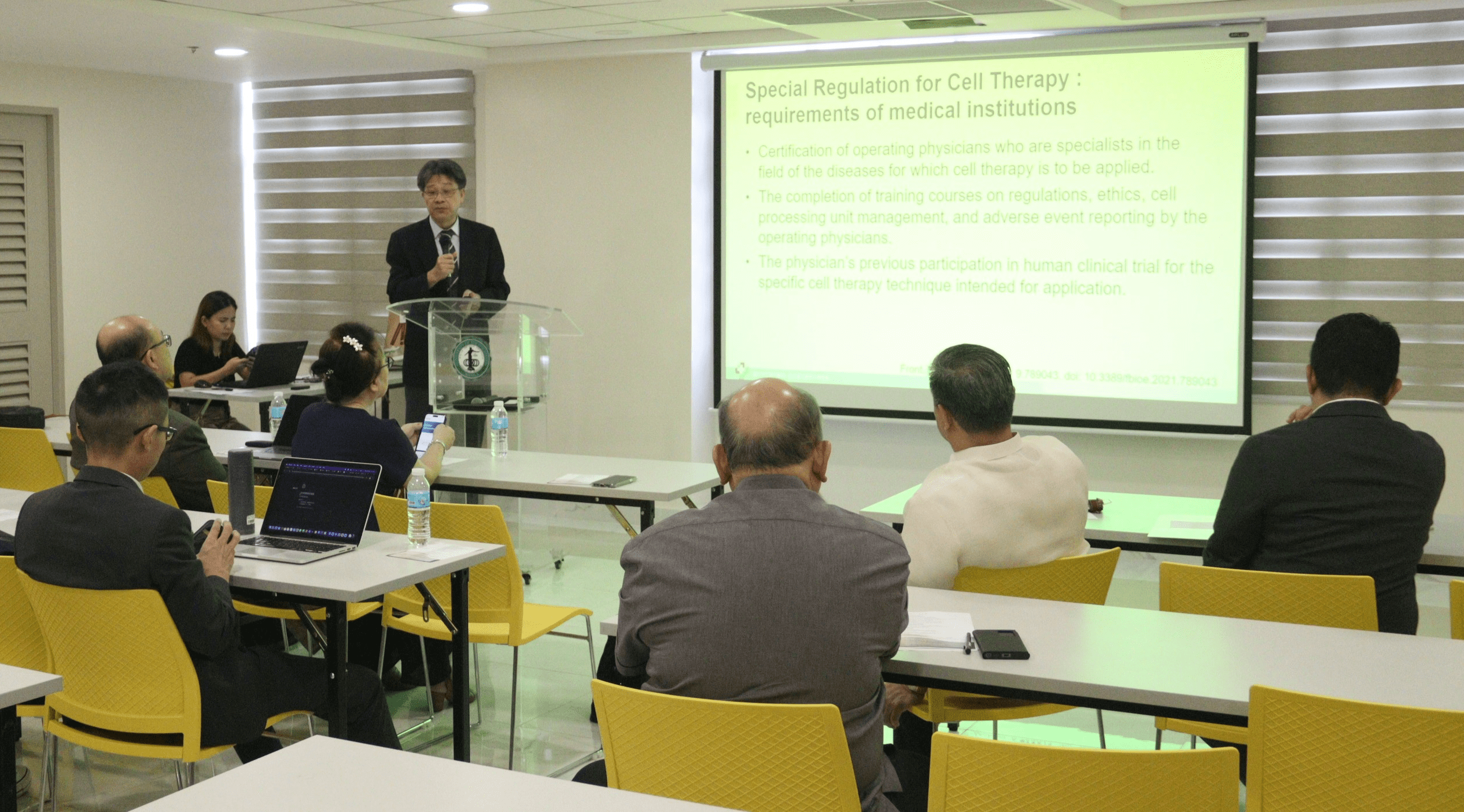
TMU Vice Superintendent Chiang Chen-Yuan discusses regenerative medicine.
“With Taiwan as a partner, we know that we can train future leaders in the Philippines, especially in healthcare.”
– Dr. Michael L. Tee, Chancellor, University of the Philippines Manila
Smart healthcare, regenerative medicine, traditional medicine, public health, communicable disease prevention and management, and other health-related issues and research were actively discussed during the International Academic Colloquium between the University of the Philippines Manila (UPM) and Taipei Medical University (TMU) Wanfang Hospital held on June 4, 2024 at the Unilab Hall of the UP College of Medicine (UPCM), Henry Sy Sr. Building.
The presentations from Wanfang Hospital included an introduction of their institution and TMU, the Taiwan Southbound Medical Collaboration Project, and Regenerative Medicine. UPM shared insights about Project UTAK AI, Smart Healthcare, Philippine Public Health, the Filipinos’ use of traditional medicine, and Communicable Disease Prevention and Management.
UPCM Dean Charlotte M. Chiong welcomed the participants and guests. “As we delve into discussions on healthy aging, pandemics, and environmental health, we recognize that these critical areas really transcend borders. They demand collective efforts, interdisciplinary approaches, and innovative solutions.”
“We envision a future marked by closer ties and fruitful collaborations. Together, we can accelerate breakthroughs in medical research. Let us collaborate on strategies to mitigate these challenges, therefore ensuring a healthier and more resilient world and region. Let us embrace this moment as a catalyst for lasting partnerships. Our shared vision to be a community of scholars with heightened social consciousness and accountability drives us forward. Together, we can make a difference, one patient, one discovery at a time,” she concluded.
Dr. Ting-I Lee, Director of the TMU-Wanfang Hospital Health Education Center, briefed the participants about their institution, highlighting their mission and vision, roster strength, medical services and characteristics, and some milestones in organ transplantation. Describing Wan-Fang Hospital as the “first public utility managed by the private sector through TMU,” she also shared their strategic defense against epidemic prevention, wherein they created an Epidemic Control Task Force which operates in shifts.
Thereafter, Dr. Ching-I Chen, TMU-Wanfang Hospital Director for Business Development, gave a talk on their Southbound Medical Collaboration Project, an initiative funded since 2018 by the Taiwan Ministry of Health and Welfare. The project aims to foster collaboration between leading medical centers in Taiwan and hospitals across several countries in Southeast Asia and the Western Pacific Regions in the following areas: smart healthcare, telemedicine, precision medicine, and traditional medicine. Among their planned activities for 2024 include hospital visits to foster collaboration through on-site exchanges, conferences in Manila and Taipei which will showcase innovative research and best practices, and reciprocal visits between TMU-Wanfang Hospital and UP Manila to strengthen partnerships through mutual learning.
Dr. Chen underscored the benefits of collaboration, which include mutual growth, healthcare advancement, and its impact, which will help address healthcare challenges in the region. Towards the end, he invited UP Manila to “transform healthcare together” through shared visions, innovation solutions, and mutual respect, which will leave a lasting legacy in healthcare.
The head of the TMU-Wanfang Hospital delegation, Vice Superintendent Chiang Chen-Yuan, gave a talk on Regenerative Medicines in Taiwan, which rested on a dual-track regulatory framework: the Medical Care Act, or “Regulation Governing the Application of Specific Medical Examination Technique and Medical Device (RASMET)” also known as the “Special Regulation for Cell Therapy,” and the Pharmaceutical Affairs Act or the “Regenerative Medicinal Product Management Act,” which is still under approval process in the Taiwanese parliament. Dr. Chiang delved on the requirements of their medical institutions for the special regulation for cell therapy, such as the certification of operating physicians who are specialists in the field of the diseases for which the cell therapy is to be applied; completion of training courses on regulations, ethics, cell processing unit management, and adverse event reporting by the operating physicians; and previous participation in human clinical trials for the specific cell therapy technique intended for application.
Dr. Chiang, a tuberculosis control advisor for the World Health Organization (WHO), also talked about the situations encountered in the application of cell therapy in Taiwan, as well as the government agencies and regulations which have the purview on RASMET and the still-pending Pharmaceutical Affairs Act. He then touted TMU’s Center for Cell Therapy and Regeneration Medicine, which was established on April 15, 2015 to facilitate cooperation between research in cell therapy, regenerative medicine, and clinical medicine. The center, which aims to strengthen international cooperation and facilitate industry-academic cooperation in the field of cell therapy and regenerative medicine, also has a Good Tissue Practice (GTP) laboratory, which provides a reliable source of cells for clinical research.
Dr. Chiang shared a case wherein cell therapy helped cure a boy who had an accident in a swimming pool which led him to develop ischemia. He concluded his presentation by sharing the positive results of their work on two cases of subjects afflicted with severe COVID-19 with associated acute respiratory distress syndrome (ARDS).
UPM Chancellor Michael L. Tee began his presentation by informing the attendees of a collaboration for research between the Taipei Economic and Cultural Office (TECO) and the Manila Economic and Cultural Office (MECO) through the co-funding of a smart hospital, telehealthcare, AI medicine prediction, and quantum computation. He then discussed Project UTAK AI: Clinical Landing and Federated Learning of Medical Imaging AI on Brain Tumors. The project, which will run from March 2024 to February 2027, will be chiefly implemented by UPM, with Taipei Veterans General Hospital, Taiwan AI Labs, and the Philippine General Hospital as partners. Dr. Tee expressed that the program will utilize magnetic resonance imaging (MRI) scans for organ visualization, machine learning such as deep learning/convolutional neural networks (CNN) to look at how the machine can diagnose metastasis in the brain (or AI-driven brain tumor detection from MRI scans), and that privacy in the program will be preserved via federated learning.
The Chancellor then shared the significance of brain tumor detection: the disease affects about 100,000 patients in the Philippines and Taiwan, and early detection is crucial for patient survival. Although it is difficult to have MRI specialists in the Philippines, the Department of Health (DOH) is planning to deploy MRI machines to apex hospitals as a response to this need. He then underscored the benefits of AI in brain tumor diagnosis, such as enhanced accuracy, time efficiency, and resource optimization, and presented the general and specific objectives of the project:
Dr. Tee then did a rundown of the Research Methodology in Medical Image Analysis, areas to be covered by federated learning, the workflow of the project, and the validation methods to be used. He concluded by highlighting the potential outcomes of UTAK AI: automated brain tumor analysis, improved clinical workflow, AI implementation experience, with which UTAK AI is heralding, and the social and economic impacts of the project.
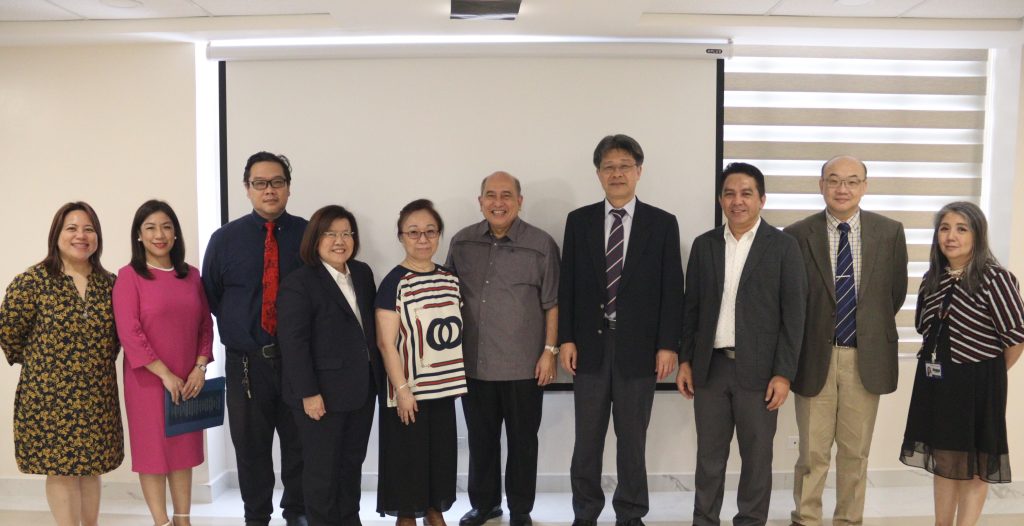
From left: Dr. Sharon Yvette Villanueva, Dr. Evalyn A. Roxas, Dr. Philip Niño Tan-Gatue, UPCM Dean Charlotte M. Chiong, Dr. Ting-I Lee, Dr. Camilo C. Roa, Jr., Dr. Chiang Chen-Yuan, CPH Dean Fernando B. Garcia, Jr., Dr. Chin-i Chen, and Dr. Angela S. Aguilar.
Next to speak was Dr. Raymond Francis R. Sarmiento, Director of the National Telehealth Center, UPM-National Institutes of Health (NIH), who discussed Smart Healthcare, specifically on implementation science and medical AI and digital health. He explained the various layers which compose the deep neural network, the significance of privacy protection and information security as well as its overlap, and some sample articles on how technology, AI in particular, has helped in clinical practice, especially in screening, diagnosis, as well as in community-based field work.
Dr. Sarmiento also delved into the applications of AI in healthcare, in particular with ophthalmology. According to him, there are AI models applicable to glaucoma, keratoconus, cataract, and other anterior segment diseases and oculoplastic surgery. “The most promising tools are currently in the field of the retina.” Thereafter, he outlined how telehealth and telemedicine is effectively used by AI-enabled service delivery networks for universal healthcare. Dr. Sarmiento concluded his talk by stating the 10 core principles on the approach to the ethics of AI: proportionality and do no harm; safety and security; right to privacy and data protection; multi-stakeholder and adaptive governance and collaboration; responsibility and accountability; transparency and explainability; human oversight and determination; sustainability; awareness and literacy; and fairness and non-discrimination.
UPM College of Public Health (CPH) Associate Dean for Research Sharon Yvette Angelina M. Villanueva gave a briefer about CPH and the different researches currently being implemented by the college, with focus on antimicrobial resistance (AMR) and leptospirosis. She underscored the One-Health Approach, a supported program of the Department of Science and Technology (DOST) which is an interaction of animal, human, and environmental health which is an effective way to elucidate the AMR resistance in the Philippines. With regard to decreasing leptospirosis, Dr. Villanueva informed the attendees about the projects implemented by CPH such as prognosis and treatment optimization through the Prevention and Control of Leptospirosis Program (LepCon): Prevention, Modelling, Treatment, Development of Prognostic Acid. She expressed hope that LepCon will have economic and social impacts not just in the Philippines but in other countries that are suffering from outbreaks of leptospirosis.
The topic on Traditional and Modern Medicine Integrated was delivered by Dr. Philip Niño Tan-Gatue, Clinical Assistant Professor in UPCM. He gave a brief background of traditional medicine as defined by the WHO, and how the Philippine Institute of Traditional and Alternative Health Care (PITAHC) was enacted to accelerate the development of traditional and alternative healthcare in the Philippines. Dr. Tan-Gatue did a rundown on the maladies which can be treated by acupuncture, such as respiratory tract disorders, disorders of the eyes, disorders of the oral cavity, gastrointestinal disorders, and neuromuscular disorders. He then presented a study made by a group of researchers including himself, titled “Acupuncture as an Adjunct to Standard Therapy for Pruritus in Patients with Atopic Dermatitis: A Patient- and Assessor blinded, Randomized, Placebo-controlled trial,” which concluded that “acupuncture is a promising adjunct treatment in atopic dermatitis with significant reduction in pruritus, disease severity, and medication use, and a trend towards improved quality of life. Studies with larger sample size and comparison to acupuncture points farther from the true acupuncture points are recommended.”
The final presenter, Dr. Evalyn A. Roxas, CPH Associate Professor and College Secretary, gave a talk on their study “Qualitative Assessment of the Process of Initial Antibiotic Therapy for Patients with Sepsis at the Emergency Department of a Tertiary Hospital in the Philippines: A Time and Motion Analysis.” The objective of their study was to assess the process of initial antibiotic therapy, from the time an antibiotic was ordered to the time the loading dose of the antibiotic was administered, for adult patients diagnosed with sepsis admitted to the emergency department. Their findings showed the following: that the ideal time of an hour to administer antibiotics was not achieved; that there is a need for collaborative and system-wide improvement; and that issues on service delivery, governance, and human resource must be addressed and resolved.
In his closing remarks, CPH Dean Fernando B. Garcia, Jr. expressed excitement at the possible areas of collaboration with TMU.
Professor Emeritus Camilo S. Roa, Jr., Chair of Research Work at UPM, acted as introductory speaker for the UPM presenters, and CM Special Assistant to the Dean for External and International Linkages Angela S. Aguilar served as the Master of Ceremonies.
After the Colloquium, the visitors toured the Philippine General Hospital (PGH) and paid a courtesy call to PGH Director Gerardo D. Legaspi.
The event was facilitated by the UPM Office of International and Local Linkages (OILL) headed by Dr. Vivian Fe Fadrilan-Camacho.