


Texts by Charmaine M. Cañizares and Dr. Ernesto R. Gregorio Jr.
Photos by Ronald Verceles
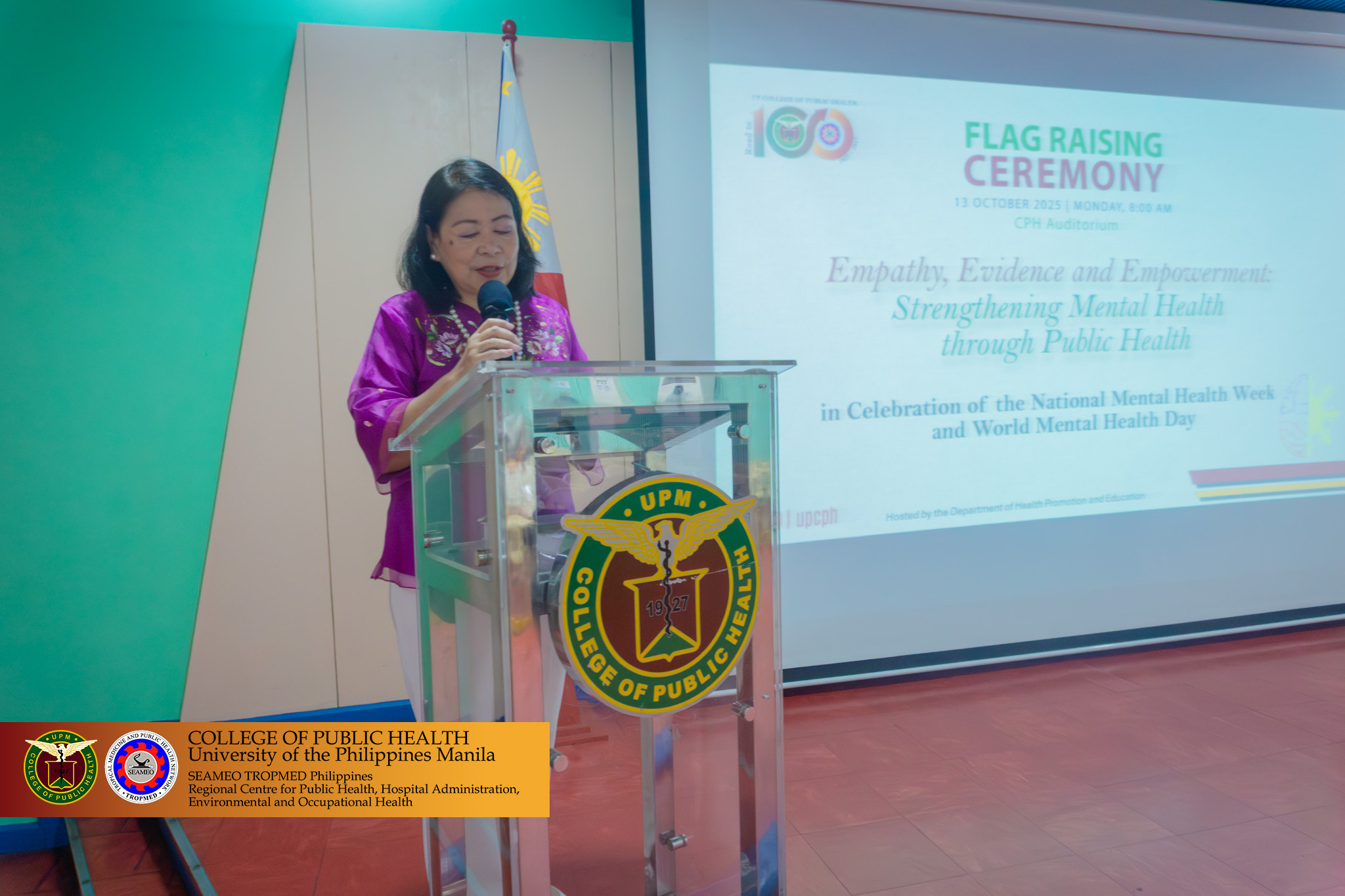
UP College of Medicine Associate Professor Maria Lourdes Rosanna De Guzman underscored the importance of integrating mental health and psychosocial support strategies into emergency response efforts.
Located along the Pacific ring of fire, the Philippines is highly susceptible to disasters, specifically typhoons and earthquakes. Just recently, President Ferdinand Marcos Jr. declared a state of national calamity following the onslaught of typhoon “Tino” allowing for the continued rescue and relief efforts to affected regions. This reflects the need for proactive measures to provide complete aid to affected populations.
Dr. De Guzman emphasized the psychological impact of natural disasters, armed conflicts, and public health crises on affected populations, particularly vulnerable and marginalized groups. In a recent discussion during the celebration of National Mental Health Week and World Mental Health Day on October 13, 2025, she highlighted three key approaches: Community Self-Help, which empowers communities to support one another through shared experiences and available resources; Psychological First Aid, which involves training frontline workers to provide immediate emotional support and practical assistance to those in distress; and Access to Care, which ensures that individuals with severe mental health conditions receive appropriate clinical treatment and ongoing support.
Dr. De Guzman, who teaches in the Department of Psychiatry and Behavioral Medicine, also stressed the benefits of a mentally healthy workplace, including higher productivity, better employee retention, and a more positive environment.
“What does a mentally healthy workplace look like? It’s a place where employees feel valued and supported, where open communication is encouraged, and stress is managed effectively, and where there is a good work-life balance with resources available for those who need help,” she explained.
“As employers and colleagues, we all have a role to play. We can start by educating ourselves about mental health, creating policies that support mental well-being, and fostering a culture where it’s okay to talk about mental health challenges,” Dr. De Guzman added.
Similarly, as anxiety, depression, and other mental health concerns continue to affect increasing numbers of Filipino youth, Dr. De Guzman said creating safe spaces where young people can openly express their feelings without fear of judgment is important. Moreover, she said mental support for the youth begins in the home but must also involve teachers and community members.
She also recommended incorporating wellness activities into academic courses and daily routines and teaching the youth to recognize signs of mental health issues in themselves and others. Dr. De Guzman also advocated for improved mental health resources in schools and communities, such as counseling services and mental health education, and led by example, showing young people that it is both acceptable and essential to prioritize their mental well-being.
“Remember, from a public health perspective, we have the power to raise awareness, reduce stigma, and encourage support for mental health. By speaking up about mental health, we can create a society where everyone feels understood, supported, and empowered to seek help when needed,” she said during the sidelines of the Flag Raising Ceremony organized by the Department of Health Promotion and Education, in collaboration with the Communications Unit of the UP Manila College of Public Health. The ceremony was attended by the faculty, administrative staff, Research, Extension, and Professional Staff (REPS), and students of the College of Public Health. The newly elected officers of the College of Public Health Student Council also took their Oath of Office during the program.
Dr. De Guzman led the first National Mental Health Survey in the Philippines, funded by the Department of Science and Technology – Philippine Council for Health Research and Development (DOST-PCHRD).