

Text by Martin Racza
Photo from Daniel Dalisay and Ivan Libao
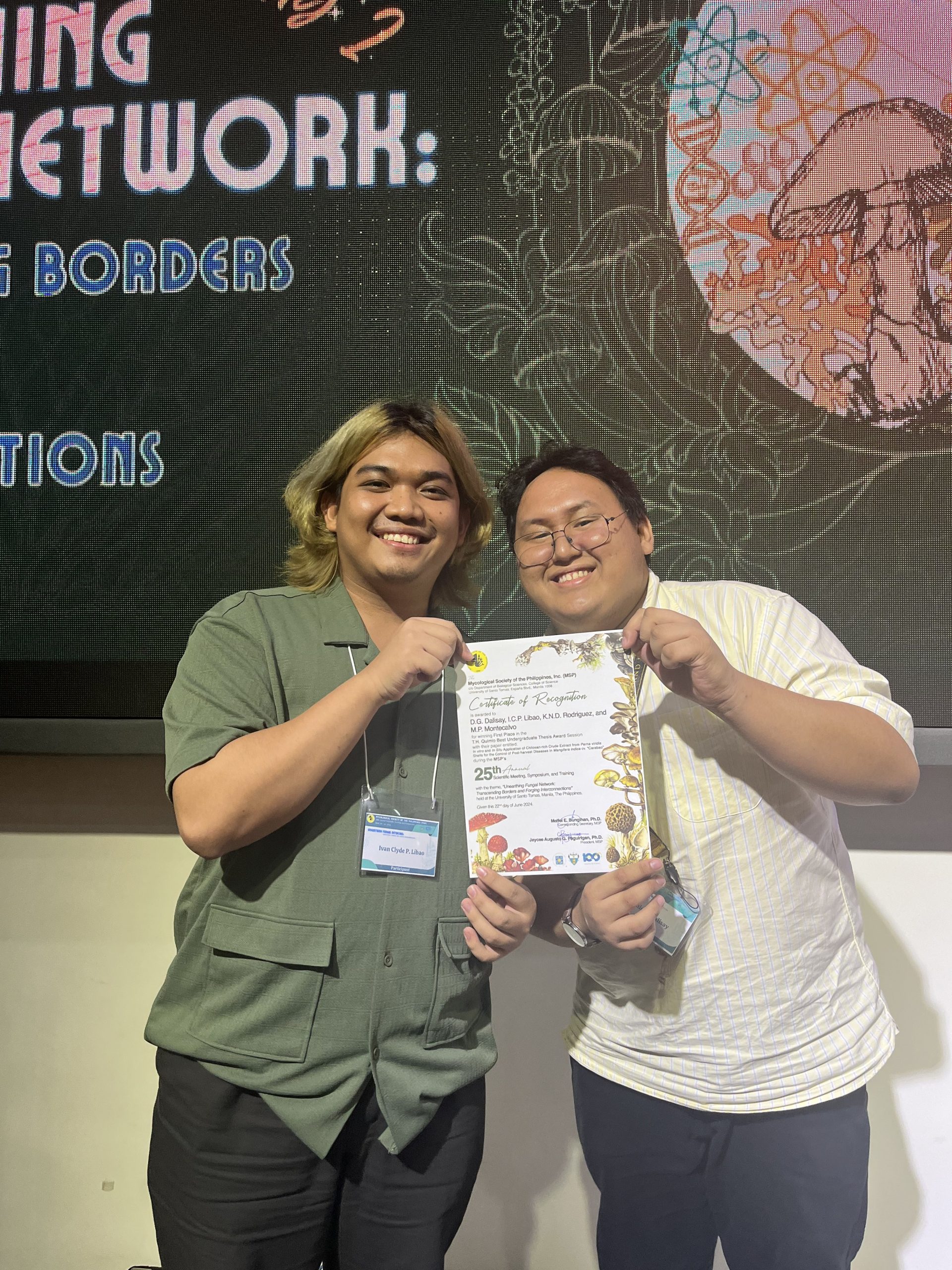
Ivan Libao (left) and Daniel Dalisay (right) holding their Certificate of Recognition for winning the T. H. Quimio Best Undergraduate Thesis Award.
Proving once again the mettle of the University of the Philippines Manila (UPM) in research contributory to the welfare of our fellow Filipinos, College of Arts and Sciences (CAS) students Daniel G. Dalisay and Ivan Clyde P. Libao bagged the T. H. Quimio Best Undergraduate Thesis Award at the Mycological Society of the Philippines’ (MSP) 25th Annual Meeting for the oral presentation of their thesis entitled “In vitro and In Situ Application of Chitosan-rich Crude Extract from Perna viridis Shells for the Control of Post-Harvest Diseases in Mangifera indica cv. Carabao.”
Saving the ‘Carabao Mango’
In an interview, Dalisay and Libao explained their choice of topic for the thesis. “‘Carabao’ mango, due to its delightful and exotic taste, has great economic value in the mango production of the Philippines. However, postharvest diseases like anthracnose compromise the quality and marketability of the fruit. The causative agents of anthracnose are members from the fungal genus Colletotrichum. Anthracnose, when left unmanaged, can result in 100% yield loss. In other countries, they apply fungicide before or after harvest to control anthracnose, whereas, in the Philippines, we usually subject the fruits to hot water treatment to reduce fungal infection. Although the use of synthetic fungicide remains as the most effective control method, the risk it poses to the consumer necessitates finding a nontoxic alternative.”
They found the solution in Chitosan. “Chitosan is a nontoxic biopolymer that has demonstrated antifungal capabilities, and it can easily be derived from shells of crustaceans and molluscs. This inspired us to attempt extracting chitosan from the mollusc tahong (Perna viridis) and observe its antifungal effect (in vitro & in situ) on fungi associated with anthracnose in ‘Carabao’ mango fruit. Furthermore, a study of Cadano et al. revealed that the greatest chitosan yield can be achieved from tahong shells when compared to other shellfishes in the country. Therefore, we can upcycle and repurpose tahong shells, which have no further economic or industrial use, as a source of chitosan.”
Presenting the Thesis
In presenting the results of their research, Dalisay and Libao said that “one of the most significant challenges was translating our comprehensive and detailed thesis into a concise and impactful presentation. This involved distilling complex scientific data into clear, compelling narratives that could be understood and appreciated by a broader audience. We had to ensure that every slide and every minute of our 10-minute presentation conveyed the essence of our research without losing critical details. We prepared extensively to anticipate and address potential questions and critiques, as our goal was to present our research with the highest level of credibility and significance.”
Their preparations were anchored on striving “to gain the respect and acknowledgment of the leading mycologists in the country by emphasizing the novelty and impact of our findings in the field of agriculture.”
For Philippine Agriculture
“Currently, we are in the process of revising our final manuscript and hope to publish it soon, as we believe it offers a promising contribution to enhancing local agriculture,” the duo said. “Our study presents a more sustainable and eco-friendly antifungal agent for mango farmers, reducing dependence on synthetic fungicides. We had the privilege of collaborating with our co-adviser, Melissa P. Montecalvo, MSc., from the National Crop Protection Center, whose extensive expertise was crucial in bringing this research to fruition. In addition to our current study, we are investigating a newly reported fungal isolate found in local mango fruits, examining its characteristics and pathogenicity.”
Dalisay and Libao are optimistic on how their thesis can help save the ‘carabao mango,’ and eventually benefit more in Philippine agriculture. “This research could serve as a foundation for future studies addressing the potential threats posed by this fungal species and the necessary countermeasures. We hope our work will not only contribute to the scientific community but also benefit the Filipino nation, aiming to uplift local agriculture and deepen our understanding of related issues.”
Expressing their gratitude to CAS and the Department of Biology, the duo said, “We owe a great deal of our success to the Department of Biology, whose support made it all possible. CAS and the Department of Biology provided resources for the conduct of our research, which were pivotal in our journey to achieving this award. Moreover, our thesis defense prior to the competition was invaluable in improving our manuscript and preparing us for the questioning. We are grateful to have had such insightful and constructive comments from our panelists for our undergraduate thesis, whose feedback was instrumental in helping us achieve this award. Lastly, we are deeply thankful to our thesis adviser, Asst. Prof. Kiara Nicole D. Rodriguez, for her encouragement and support from proposal writing, experimentation, up until joining the annual undergraduate research competition of MSP.” #