


Text by: Jennifer F. Manongdo
Photo by: Joseph A. Bautista
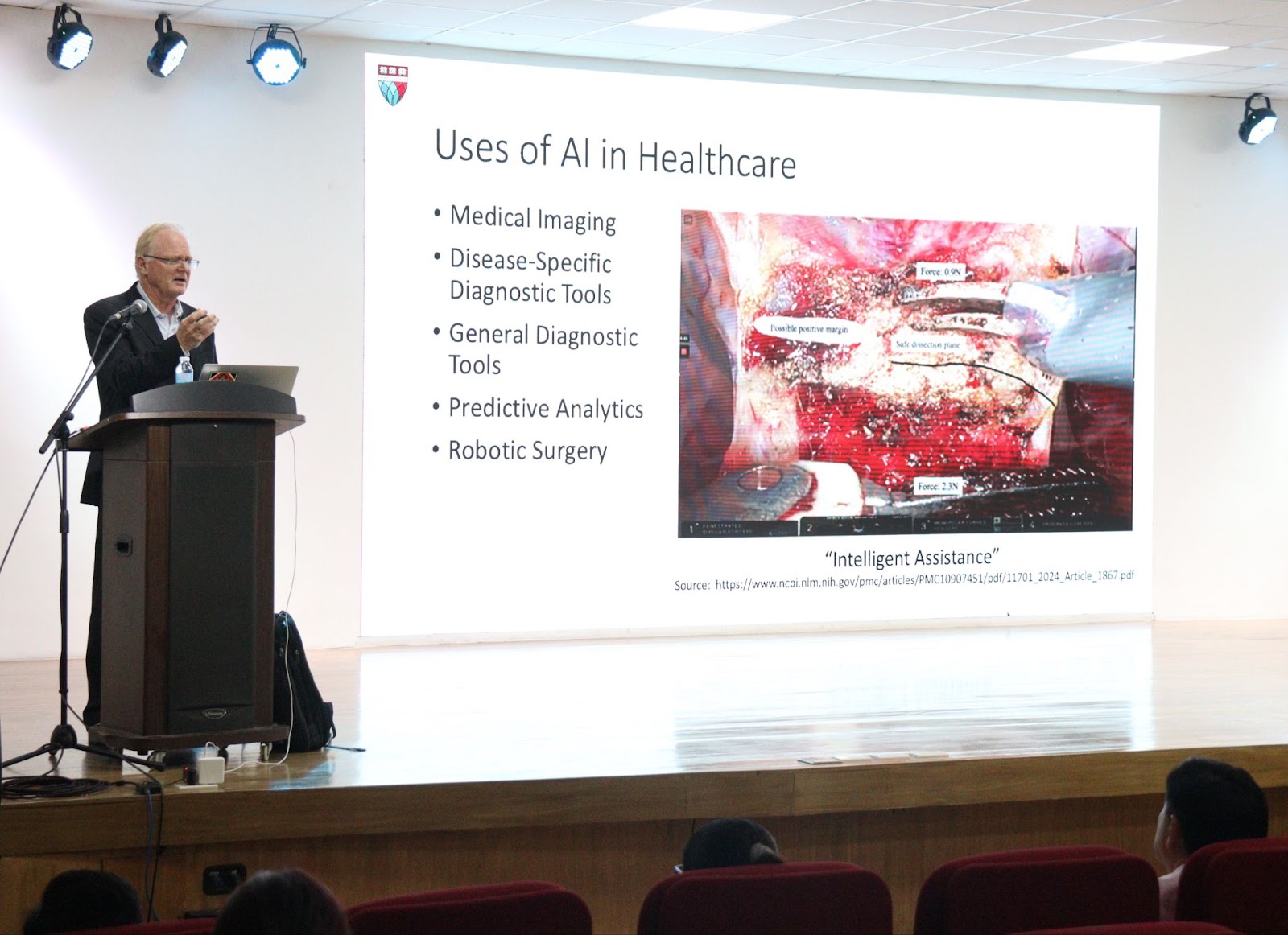
Dr. William W. Fisher, Harvard University Professor of Intellectual Property Law, speaks during his lecture on ‘The Law and Ethics of AI in Healthcare’ at the College of Nursing Auditorium on Sept. 18, 2024.
Innovations in healthcare are rapidly evolving. Just recently, doctors from Saudi Arabia performed the first-ever robotic heart transplant on a 16-year-old suffering from stage four heart failure. The use of Artificial Intelligence (AI) in diagnosis and treatment is unstoppable. AI is bound to revolutionize medicine even in remote areas where professional healthcare is scarce.
AI holds immense potential to revolutionize healthcare delivery in countries with a low doctor-to-population ratio, like the Philippines at 0.7 doctors per 1,000 population or roughly 11 Barangay Health workers per 1,000 population. AI-powered solutions can fill in the gaps in primary healthcare.
“These healthcare workers carry with them, smartphones. They depend on these devices for added information and to provide advice. The application of trained data is increasingly done through mobile apps whose efficacy has been verified in the literature. So, you can see the opportunity here. If we’re already using specific diagnostic tools on smartphones carried by health workers, why not add to it a general diagnostic tool like Med-PaLM 2? These apps have already demonstrated a capacity of diagnosis comparable to a physician,” Harvard University Professor of Intellectual Property Law, Dr. William W. Fisher said in his lecture on ‘The Law and Ethics of AI in Healthcare’ at the College of Nursing Auditorium on Sept. 18, 2024, organized by the Office of International Linkages.
Med-PaLM and its second version, Med-PaLM 2, is a large language model (LLM) designed by Google to provide reliable answers to medical questions by drawing from a large set of real questions and answers from patients and providers, as well as medical licensing exams, medical research, and consumer queries stored in various databases.
Dr. Fisher said AI-enabled tools such as Med-PaLM 2 can enhance the capabilities of Barangay Health Workers by providing sound medical advice and information.
On a broader scale, AI can potentially increase the accuracy and early detection of diseases. It also increases personalization of treatment which leads to healthcare expenditure savings. AI can also help reduce nurses’ workloads through the use of chatbots. In one of his presentation slides, Dr. Fisher referenced a story from the American College of Surgeons Foundation, illustrating how chatbots can be used to answer simple patient questions.
Role of AI in Healthcare
AI algorithms can analyze medical images, patient data, and symptoms and assist in providing preliminary diagnoses. It can detect early signs of diseases leading to improved outcomes. In addition, AI can power disease-specific diagnostic tools such as the IDx-DR software which detects early signs of diabetic retinopathy. AI can also be used in general diagnostic tools and provide predictive analytics such as the Epic Sepsis Model which estimates the possibility of sepsis in hospital settings. AI can also assist in the development of new drugs.
Challenges and Considerations
Since AI in healthcare is practically new, it carries some challenges that healthcare providers need to watch out for. One of these needs is making a diagnosis.
“AI systems make mistakes…Epic Sepsis Model, has turned out to be not as good as it was originally touted to be,” Dr. Fisher said.
In addition, there is also the issue of wrong interventions and privacy invasions which becomes an issue when there is a data breach or unauthorized access to personal data. AI also poses a threat to autonomy as it influences our decisions. There is also the issue of dehumanization of healthcare as in the case of “Pepper,” a humanoid robot that welcomes patients and visitors in a hospital in Belgium. The use of AI can also lead to potential discrimination, such as in the allocation of scarce drugs or medical care, disproportionately disadvantaging poor and minority populations.
The Future of AI in Healthcare
AI, when programmed properly and implemented responsibly, can revolutionize healthcare. But there is much to be done especially in protecting the rights of patients and the healthcare worker themselves. Dr. Fisher proposed that there should be increased regulation on the uses of personalized information as well as separating compensation and deterrence in tort liability. He also proposed an expansion of pre-clearance of AI by Regulatory Authorities as well as an improvement in AI systems that would lead to reduced discriminatory impact and inequality.