

Photo by Erlyn Pareja, Sarah Pulumbarit, and Joseph Bautista
Text by Angelou Mendoza
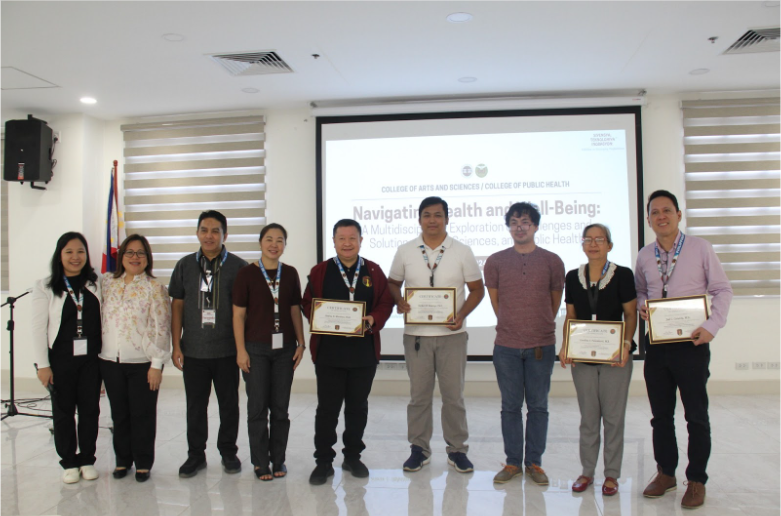
College of Public Health and College of Arts and Sciences faculty presented their respective topics on healthcare and answered questions from the attendees on the third day of Science and Technology week.
In the continuation of the lecture series of the 20th Science and Technology Week, the fourth day focused on the overarching discussion on challenges and solutions in the overall health of Filipinos and its relation to arts and sciences last Nov. 21, 2024, at the Henry Sy Sr. Hall Building. The lecture series was filled with thought-provoking discussion led by the experts and faculty members of the College of Arts and Sciences (CAS) and College of Public Health (CPH) in the morning with the theme, “Navigating Health and Well-Being: A Multi-disciplinary Exploration of Challenges and Solutions in Arts, Sciences, and Public Health.”
CAS Department of Biology Assistant Professor Joel Cornista began the morning session with his lecture on “Antimicrobial Resistance in the Post Pandemic Era: Challenges and Concerns,” which emphasized AMR as a persisting worldwide major health concern due to overuse, misuse, and abuse of antibiotics. He also introduced bacteriophage therapy, an in-progress study that can potentially resolve AMR as an eradicator of multidrug-resistant bacteria.
An eye-opening discussion on the status of domestic workers abroad was delivered online by Dr. Andrea Martinez of the Department of Behavioral Sciences, “CAS–Strength Across Borders: Developing Mental Health Intervention Program for Filipino Migrant Workers.” She underscored the need for cultural adaptation of mental health intervention programs and the mental health and help-seeking behavior of migrant workers, which involved homesickness, adjustment problems, depression and loneliness, anxiety, addictive behavior such as gambling and substance abuse, and poor mental health outcomes due to social and financial barriers.
“Family Caregiver Narrative on Providing End-of-Life Care to Siblings,” a lecture presented by Director of Sentro ng Wikang Filipino Carolina Pulumbarit in which she explained end-of-life care as emotional and moral support and medical assistance provided for a person nearing death and had real-life samples of situations. She underscored the mental, physical, and spiritual needs of the person, as well as the care dynamics and role of relationships in providing end-of-life care. Her discussion emphasized both the needs of the patient and the caregiver.
The last presenter from CAS was Dr. Herbert Domingo of the Department of Physical Sciences and Mathematics, who discussed “Time in Quantum Theory and the Modified Time Kernel Equation.” In his discussion, he introduced the concept of time as related and present to various natural phenomena, time of arrival, the time kernel equation, and its modified version – concepts that contribute further to the development of health-related technologies.
The College of Public Health experts also dominated the morning session with discussions introducing Universal Health Coverage as a program that amplifies health equity in the country, pediatric COVID-19 vaccination, and the impact of health and nutrition programs.
Dr. Leizel Lagrada of the Department of Health Policy and Administration (DHPA) discussed her lecture on “Program for Health Equity: Translating the Universal Health Coverage Principle of Health Equity into Action.” Her discussion highlighted the underserved Filipinos despite the many reforms in healthcare policies. In collaboration with the Zuellig Family Foundation, UP CPH launched a program for health equity on March 1, 2023, that aims to provide health equity learning series, evidence generation for health equity and disparities in the country, and lastly, policy guidance will lead to creation of inclusive policies in health.
Discussed in “A Quantitative Study on the Drivers of Pediatric COVID-19 Vaccination Uptake in the Philippines” of Dr. Maria Margarita Lota of the Department of Medical Microbiology were the key drivers/ enablers of pediatric COVID-19 vaccination, that were perceived protection of vaccines, government regulations, and health care workers recommendations, while barriers were low perceived need for vaccination and lack of vaccination confidence. She also highlighted that findings in her study can be used to improve immunization activities for children.
Lastly, Dr. Kim Leonard dela Luna on “Perceived Impact of Health and Nutrition Programs among Beneficiaries of a Civil Society Organization in Selected Municipalities in the Philippines” emphasized the importance of health and technical nutrition programs for families and communities as a source of help and information. The programs also include gender empowerment and financial literacy through teaching on how to save money. Few recommendations of the study were further development of programs and empowerment of beneficiaries.
Also present at the morning session of the lecture series were the College of Arts and Sciences Dean Maria Constancia Carillo and College of Public Health Dean Fernando Garcia, Jr.
Evidence-Based Research in Health-Related Legislation and Implementation to Boost UHC
Presenters for the afternoon session of the S&T week 4th day with faculty members and scientists from the Office of the Vice Chancellor for Research (OVCR) and the National Institutes of Health (NIH).
The afternoon session was led by the Office of the Vice Chancellor for Research (OVCR) and the National Institutes of Health (NIH) guided by its theme on “Strengthening UHC with Evidence: Informing Policy for Effective Implementation.”
The presentation of “Profile of research projects on COVID-19 from the health sciences center of the national university of the Philippines: An analysis of a university-wide database” discussed by Cheene Mabelle Calantoc and Ionee Ibarrientos-Bonotan with guidance of Dr. Mark Anthony Sandoval highlighted the interconnection between universities, research, universal health care, and pandemic among the studies on COVID-19, which are mostly funded by Philippine Council for Health Research and Development (PCHRD), Department of Science and Technology (DOST), and Department of Health (DOH).
This lecture was followed by the “Access to Medicines of Hypertensive Drugs in an Interlocal Health Zone in Cavite, Philippines,” in which Asst. Prof. Frances Lois Ngo of the College of Pharmacy (CP) highlighted a few important points, such as strengthening the implementation of medicine-related policies and the need to improve the availability of essential medicines in the communities. To assess the affordability and availability of medicine, the study used WHO/HAI methodology.
Assoc. Prof. Mac Ardy Gloria on “A Cost-Effectiveness Analysis of Brief Intervention Programs on Physical Activity in the Philippines” showed that the issue of physical inactivity has not yet been addressed despite being persistent among adults. This study showed brief intervention program counselling as a cost-effective intervention that will aid in the physical inactivity.
Research Assistant Professor Haidee Valverde on “Evaluating the Cost-Effectiveness of HIV Self-Testing vs. Facility-Based Testing in the Philippines,” showed that both were cost-effective and efficient, but facility-based testing is more of quality.
“Cost-Effectiveness of PD vs. HD in Pediatric ESRD Patients” of Dr. Christine Caringal showed peritoneal dialysis for pediatric patients is more cost-effective with patients having more quality-adjusted life years and heart function is more preserved, unlike hemodialysis, which is prone to blood pressure instability.
Dr. Rohani Navarro from the Institute of Molecular Biology and Biotechnology discussed the “Addiction is a (Reversible) Brain Disorder” in which laboratory rats were observed through an experiment to see differences in behavior when exposed to an addictive substance and also see solutions on reducing drug-seeking behavior.
“Animal Models in Depression Research: The Role of Sex Differences” of Research Assistant Professor Richelle Ann Manalo-Cabalinan experimented on laboratory male and female rats to induce depressive-like behavior and see the differences in behavior. This study suggested that females are more vulnerable to stress than males hence, sex-specific treatments should be developed and funded for support, especially since depression is a common mental disorder.
Institute of Herbal Medicine (IHM) Director Cecila Nelia Maramba-Lazarte presented the “Philippine Herbal Medicine Development Plan,” showcasing the goals of the institute and the products of the IHM National Integrated Research Program on Medicinal Plants (NIRPROMP), such as the Lagundi (Vitex negundo) tablet and syrup, Akapulko lotion, Yerba Buena tablet, Ampalaya tablet, and Tsaang Gubat tablet and syrup which are developed to alleviate the high cost and inaccessibility of medicines and healthcare.
“UP Manila Wellness Initiative for Seniors and Elders (UPM WISE) Research Program, 2022-2024” by Research Assistant Professor Angely Garcia had three projects last June 30, 2020 with an objective to come up with a framework on health and wellness of UP Manila employees with age ranges from 50 years old and above, which will be necessary in the UP Manila community research and development.
Institute on Health Policy and Development Studies Director Hilton Lam on “The Science of Universal Health Care” explained UHC can lead to higher health security, higher health literacy, and higher healthcare literacy and the status of UHC in the Philippines.
Lastly, “MMDA Traffic Enforcer’s Health Study” by Research Professor Emmanuel Baja tackled the health status of traffic enforcers who are exposed daily to air pollution and its association with the presence of heavy metals in the blood, black carbon, and cardiovascular diseases. Few of the suggestions for this were the development of guidelines on occupational health safety of personnel working on the streets, sufficient compensation, and programs to lessen the Manila pollution.