

Text by Jennifer F. Manongdo
Photo by UP Manila MSSR
The University of the Philippines Medical Students for Social Responsibility (MSSR) launched a comprehensive Filipino sign language handbook on health-related terms to enhance healthcare delivery to patients with hearing impairments.
Comprising five sections, the MediSIGN handbook covers a range of essential topics: Introduction, Filipino Sign Language (FSL), Alphabet and Numbers, Building Rapport, and History Taking.
Recognizing the challenges inherent in communication among healthcare providers and patients with hearing impairments, the handbook “intends to bridge communication gaps between patients with hearing impairments and medical professionals,” Alex Nathaniel B. Gagalac, Commissioner – Standing Committee on Public Health, MSSR explained.
MediSIGN is meant as a quick reference material for healthcare professionals, medical students, and the public to establish a better rapport with deaf patients in healthcare settings.
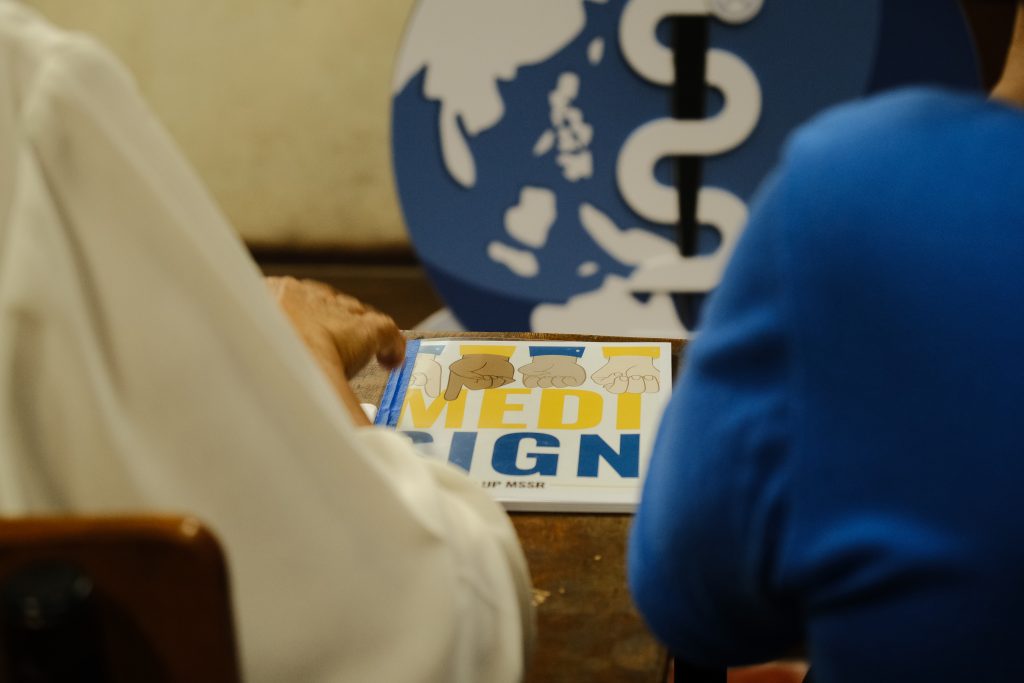
The Handbook’s Introduction delves into the basics of FSL and important elements like handshape, location, movement, palm orientation, and non-manual signs for effective communication with deaf patients. The main sections cover crucial aspects: alphabet, numerals, adverbs, and strategies to build rapport among deaf patients focusing on establishing connections through sign language, making self-introductions, and responses to inquiries. Finally, the History Taking section of the book provides essential signs for obtaining a complete medical history including health complaints, associated symptoms, and other health-related details.
In the Philippines, hearing loss affects about 15% of the population, and approximately 540,000 Filipinos utilize Filipino Sign Language (FSL) as their primary means of communication. Despite this, many deaf individuals encounter challenges in communicating with healthcare providers, leading to dissatisfaction with the physician-patient interaction, primarily attributed to linguistic differences.
“While healthcare workers can resort to the simple written form, bridging the communication gap through their “native” language – the FSL – substantially enhances and expedites the therapeutic relationship and healthcare delivery. This will greatly improve patient communication skills and promote inclusivity in healthcare, creating an environment wherein every Filipino is heard,” Gagalac emphasized.
The MediSIGN Handbook began as a collective project initiated by MSSR applicants during the 2021-2022 term and was subsequently endorsed by the MSSR Standing Committee on Public Health. It was finalized this year in collaboration with the Philippine Association of the Deaf, Inc.
A copy of the handbook may be requested through this link: tinyurl.com/MediSIGNDigitalRequest)