
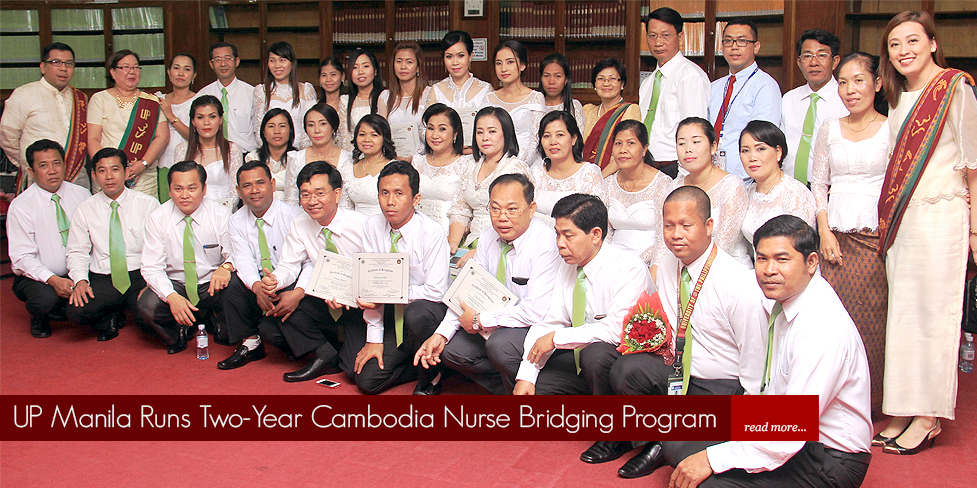
Faculty members of the UP Manila College of Nursing conducted an upgrading program that enabled Cambodian nurses to bridge into the BS Nursing and helped them become better care providers, educators, researchers, and manager-leaders.
From February 2013 to November 2014, 11 UPCN mentors of varied expertise went to Phnom Penh once a month and held classes for one week for 29 nurse faculty members of the University of Health Sciences-Technical School for Medical Care (UHS-TSMC). In addition, two nurses from the Philippine General Hospital shared their expertise in psychiatric nursing, mental health nursing, and intra-operative nursing. Three UHS-TSMC faculty assisted the UPM faculty in the Cambodia Nurse Bridging Program (CNBP).
The program was conducted under the auspices of the World Health Organization as part of UPCN’s designation as WHO Collaborating Center for Leadership in Nursing Development. On January 28, 2015, the nurses were conferred their BSN degree by His Excellency, UHS Rector Prof. Saphonn Vonthanak.
Learning experiences
Used to caring for patients in the hospital and clinic setting, the nurses were taught to care for other groups of clientele, such as families, communities, and the sick or well and in all settings. UPCN mentors demonstrated how clinical teaching strategies were utilized in simulated or actual nurse-patient encounters. They also introduced the concept of specialization in the curriculum.
Four health facilities served as venues for the training. At the Psar Doem Thkov Health Center, nurses were taught concepts on Primary Health Care. They learned how to carry out prenatal/post partum care and care of infants and children that were traditionally assigned to midwives.
In caring for families, pairs of students were assigned a family who were provided interventions to control communicable and non-communicable diseases. Caring for populations and communities entailed a diagnosis that assessed the risk factors for the people’s health problems; reviewed health center records; and conducted key informant interviews, focus group discussions, and ocular surveys. The results of such activities served as basis in developing a health program for the community.
At the government-run Khmer-Soviet Friendship Hospital, nurses were trained on caring for acutely and chronically ill adults and children. The Operating Room experiences, psychiatric and mental health nursing experiences and caring for women in labor also took place in this tertiary hospital.
Calmette Hospital, a private tertiary facility, exposed the nurses to critically ill patients and developed their management and leadership skills. For the care of children across age groups and health spectrums, the students were deployed in a specialty tertiary center, the National Pediatric Hospital.
During the recognition ceremony, Mr. Chea Palo, one of the graduates, found the course useful and with deep meaning for them in developing their knowledge and capacity in nursing research, theory, community nursing, mental health nursing, nursing management, nursing leadership, and patient safety.
“We will continue to bring and share the knowledge not only with teachers and students but other health professionals in Cambodia to get better more and more in the future,” he intoned.
For her part, Chancellor Carmencita Padilla said that UP Manila is proud and honored to be a partner in this program.
“The program affirms the critical role and significant achievements of UPCN through the years in developing nursing competencies at the local and global settings,” she declared. She thanked the WHO, UHS-TSMC, and Cambodia’s Ministry of Health for the opportunity to assist in the further development of the Cambodian health system through the bridging program viewed as a good model for in-country capability building.
WHO Technical Officer for Human Resources for Health Dr. Hazarika Indrajit said that as Cambodia experiences demographic and epidemiological transition, the roles of its health workers, including nurses, are rapidly evolving as they are tasked with wider health responsibilities. He expressed optimism that with the right skills and knowledge, the graduates, who are the next generation of nurses, can make a bigger difference for patients, communities, and the national health care environment.
“The real opportunity is in mastering complex, multi-faceted issues that impact on the health system and our country. It’s more than knowing how to perform tasks and procedures, it’s about being an effective member of the health care team and navigating health systems,” he told the graduates.
Apart from UHS Rector Prof. Vonthanak Dr. Hazarika and Chancellor Padilla, the recognition ceremony was attended by Consul Myca Fischer of the Philippine Embassy, UHS vice rectors and deans, UPCN Dean Lourdes Marie Tejero, CNBP Directors former UPCN Dean Araceli Balabagno and Prof. Luz Barbara Dones, and UPCN faculty members Profs. Jenniffer Paguio and Arnold Peralta . (Based on the report “Cambodia Nurse Bridging Program: A Brief)