


Health starts from the womb and from conception until 1000 days when a child is two years old is the most critical period for his/her physical, mental, and intellectual development.
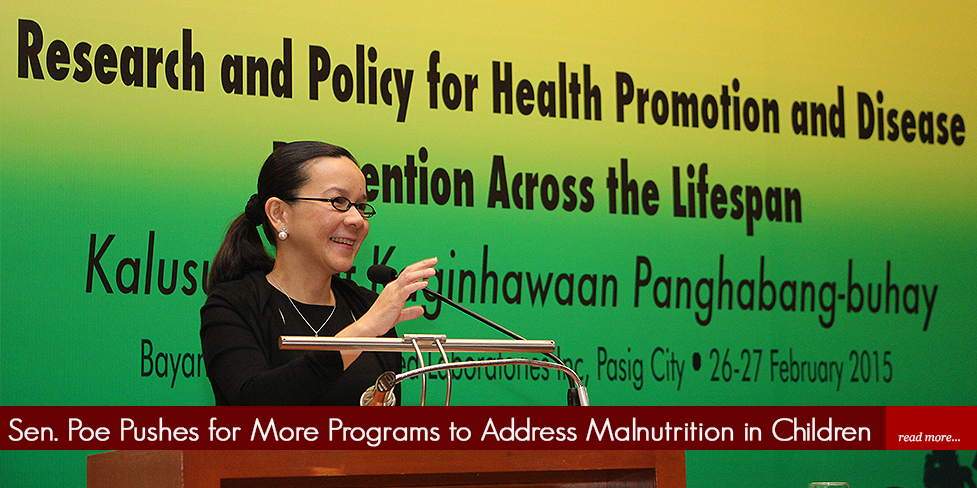
Senator Grace Poe, chair of the Senate Committee on Public Order and Mass Media, emphasized this during a keynote speech at the opening of the 17th anniversary celebration of the National Institutes of Health and 13th Science and Technology Week on Feb. 26 at the Bayanihan Hall, United Laboratories in Mandaluyong City.
“Malnutrition during this critical development for a child has not been adequately addressed in the Philippines. Although there are supplementary feeding programs which are being undertaken by the Department of Social Welfare and Development and the Department of Education, these programs started when children were beyond two years and were already in elementary school,” the senator explained.
With Asst. Secretary Dr. Paulyn Jean Rossell Ubial gracing the occasion to represent Acting Health Secretary Janette Garin, Senator Poe took the opportunity to propose that the Department of Health look into the possibility of establishing a program to provide the nutritional needs of children during the first 1000 days. This will prevent damages to health, physical growth, and brain development of children affected by chronic undernutrition.
”We have a day care program and a program for maternal care but we haven’t institutionalized a program like this. The first 1000 days refers to the start of a woman’s pregnancy until the child’s second birthday. Brain and nervous system development begins early in pregnancy and is largely complete by the time the child reaches the age of two,” she declared.
The 2013 senatorial elections topnotcher revealed Senate bills that would push for health, wellness, and disease prevention across the lifespan which was the theme of the conference that marked the celebration. Within almost two years of being in the Senate, she has filed 130 measures, the most notable of which is the Freedom on Information Bill with the rest mostly on health, food and agriculture, and disaster management.
“The first bill I filed was the Sustansiya ng Batang Pilipino Act. I felt that the government should actually provide free lunch for public school children. And the reason is that the Philippines ranks so high in the number of school drop outs not because of tuition fees or any other situations or problems but because of not enough food,” she pointed out.
She also announced a measure filed in the Senate seeking approval of a budget that will at least address the severely wasted, or the severely malnourished in the country’s public schools starting next year. Under this program, about 2 million Filipino children will have free lunches in school.
She recalled a previous government program sponsored by USAID where the government gave free nutribuns to schoolchildren. She lamented that the Philippines ranks so high in the number of school drop outs not because of tuition fees or any other problems but because of not having enough food.
Senator Poe filed another measure, Senate Bill 1283, which seeks to create a P1 B cancer fund for cancer patients. With four Filipinos dying every hour from this disease, the senator said the fund can help cancer patients cope with this debilitating illness. The abolition of the Priority Development Assistance Fund, she said, prevented legislators from giving cash to patients for medicines and painkillers. The limited funds provided by referral facilities, such as the Philippine Charity Sweepstakes Office and the Philippine General Hospital decrease access of patients to needed treatments.
Due to the continued scourge of diabetes among Filipinos, including children, she also filed a bill to assess and formulate strategies to stop the impending diabetes epidemic in the country. She attributed this to the proliferation of and easy access of the people to fast foods and waning interest on preparing nutritious foods. She revealed that less and less Filipinos now eat vegetables, with the Philippines among Asian countries with low vegetable consumption.
She said that successful nutrition programs have common elements: political commitment, strategy, presence of skilled health workers collaborating with communities, effective communication and advocacy, multi-sectoral integrated service delivery, and sound evidence and analysis.
Senator Poe acknowledged that the NIH has an important role to play in the quest to provide Filipinos access to effective but affordable medicines and the vital role of researchers in ensuring health promotion and wellness.
“Without you, we will not be able to complete any task. It is important that we have your inputs and valuable advice on certain matters,” she told the audience composed mostly of scientific experts and health researchers.
As sidelights, she regaled the audience with anecdotes on her late father, National Artist and actor Fernando Poe, Jr. and how he used the power and influence of film to help achieve peace and champion the fight for our Muslim brothers in Mindanao.