

August 26, 2019 — With the shared goal of promoting health among members of the education sector from all parts of the world, the ASEAN University Network-Health Promotion Network (AUN-HPN) held its 2nd International Health Promotion Conference with the theme Moving towards Healthy Universities in Asia on August 19-22, 2019 at the Novotel Manila Araneta Center in Cubao, Quezon City.
The four-day event served as a venue for faculty, students, officials, experts, and researchers to exchange knowledge and best practices and foster collaboration in health promotion programs, projects, and activities.
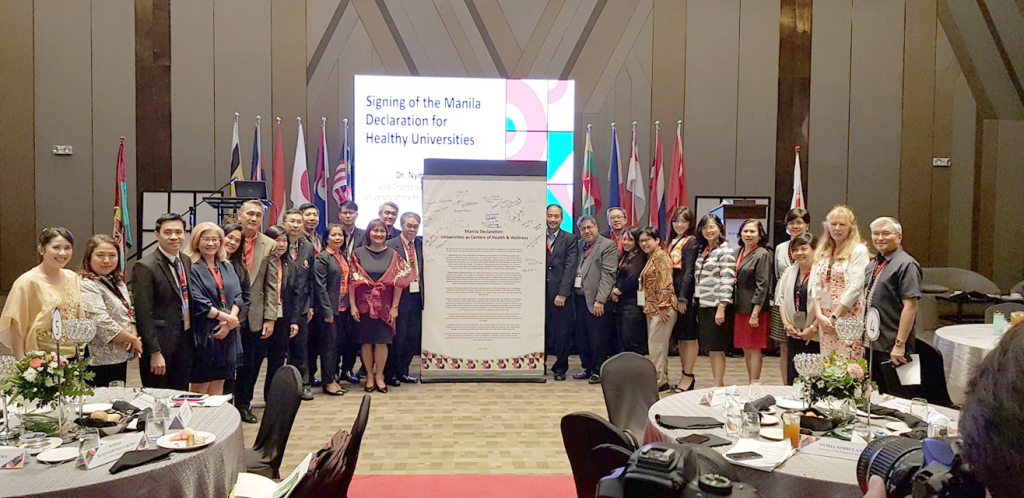
In his opening message, UP President Danilo Concepcion, represented by Executive Vice President Teodoro Herbosa, emphasized the significance of the event with the signing of the historic Manila Declaration for Healthy Universities among member universities which was held on the third day of the conference. The Declaration, a vital and historic output of the conference, aims to enhance the development of health-promoting universities and the implementation of programs on the “Healthy University Framework.”
AUN Executive Director Dr. Choltis Dhirathiti announced an increase in the abstract submissions for this year’s conference, numbering 170 from 74 universities and agencies in eight countries. He said that this demonstrates how much the faculties and researchers are actively promoting health in their respective universities and countries.
Dr. Nopraenue Sajjarax Dhirathiti, Vice President for International Relations and Corporate Communications of Mahidol University in Thailand, hoped that with the development of the ASEAN Rating on Healthy University, it can be utilized as a friendly tool and benchmarking goal to make the university environment and ecosystem healthier for the staff and students. She added that the ultimate goal of the AUN-HPN is to see the framework echoed among member universities and embraced as one of the university’s pillars and core vision and mission.
In his message, Commission on Higher Education Chair Dr. J. Prospero de Vera III stressed that in the Philippines, the past two years witnessed significant increases in investments
in higher education such as the provision of free public higher education. He noted the importance of the event because these investments will not have returns if their young beneficiaries are not healthy both in the mental, psychological, and physical senses.
Keynote speaker and DOH Secretary Hon. Francisco Duque III recognized that health promotion encompasses all sectors. He said that with the Universal Health Care law, a new era of health promotion will be ushered in in the Philippines.
In the afternoon, the first plenary discussion on Health Promotion in Universities in Asia was held introducing a framework that would help universities move towards what is deemed to be a healthy university. According to Prof. Teo Yik Yang, Dean of Saw Swee Hock School of Public Health National University of Singapore, “the measure of health promotion
is not just the knowledge but the values system instilled in the students and staff. ” He explained that for a very long time, the university is seen as a place where students pick up the necessary skills to build their careers and to advance their country. The shift he is encouraging is the nurturing of the health and wellness mindset and lifestyle among the students and staff.
Dr. Guia Tan of the Ateneo School of Medicine and Public Health gave an example of how a mentoring scheme practiced in the School can also be used as a program or intervention to help protect mental wellness and promote the mental well-being within a university. Dr. Wiwat Rojanapithayakorn, AUN-HPN Executive Director, gave a better understanding of the mission of the universities using the ASEAN University Network Health University Framework. The framework involves potential initiatives for student, staff, and community wellness. Areas that should be covered in a health-promoting university are Curriculum, Environment, Health Promotion Programmes, Policies and Provision on Healthy Eating, Smoke-free Area, Alcohol and Drugs, Student Induction Programmes, Investing in Staff, and Research.
The second plenary discussion talked about Teaching and Learning Health Promotion. Ateneo School of Medicine Public Health Dean and former Health Secretary Dr. Manuel Dayrit discussed health promotion from his perspective as former health chief. He identified the iodization of salt, measles immunization, and the signing of the Generics Act as among the milestone accomplishments. He also mentioned the crucial role of mass media in health promotion especially in this day and age. Dr. Dayrit mentioned that aside from creating good messages to propagate, the challenge in health promotion includes managing controversies. As an example, he cited the Dengvaxia controversy which eroded the public’s trust in vaccines that led to a huge drop in immunization coverage followed by outbreaks in many provinces in the country.
UP Manila Chancellor Carmencita Padilla presented the health promotion endeavors of the university through its teaching, research, and public service functions. Among these are the Psychosocial Wellness Network, Community Health and Development Programs, the extension programs per college, Lift UP app, Awakening Seminars, UP Med Webinars, and the policies developed from researches conducted by the National Institutes of Health. The latter include the Newborn Screening Act, National Hearing Screening Act, Rare Diseases Act, and the recently-enacted National Vision Screening Act.
Apart from the plenaries, a total of 75 parallel sessions were held on specific topics on health promotion while 48 posters on a wide range of health promotion themes were exhibited at the lobby. The parallel sessions were on the following topics: Integrating Well-being Competencies and Mental Health Promotion Initiatives in an Inclusive College (CSB), Healthy Settings and Healthy Behaviors, Health Promotion in Different Life Stages, Mental Health in Academic Settings, Alcoholic Beverage Consumption in the School and in the Workplace Settings: A Situationer, Use of Technology in Health Promotion, Health Promotion in Healthcare Settings, and Mental Health in Special Situations.
One of the studies presented was entitled “Evaluation of the UP Manila Staff Development Program: The Awakening Seminars” delivered by Human Resource Development Office Director Richard Javier.
Anne Marie Alto | Published in UP Manila Healthscape July – August 2019