


The COVID-19 pandemic had an encompassing effect on dental education. Dental schools adapted with alternative learning modalities but clinical training and field rotations have been discontinued. Uncertainties on how dental education will move forward in the coming academic year and how graduating students will continue with their pending requirements; and the challenges of dentistry as one of the riskiest profession in the time of COVID-19 have brought increased anxiety to future dental professionals.
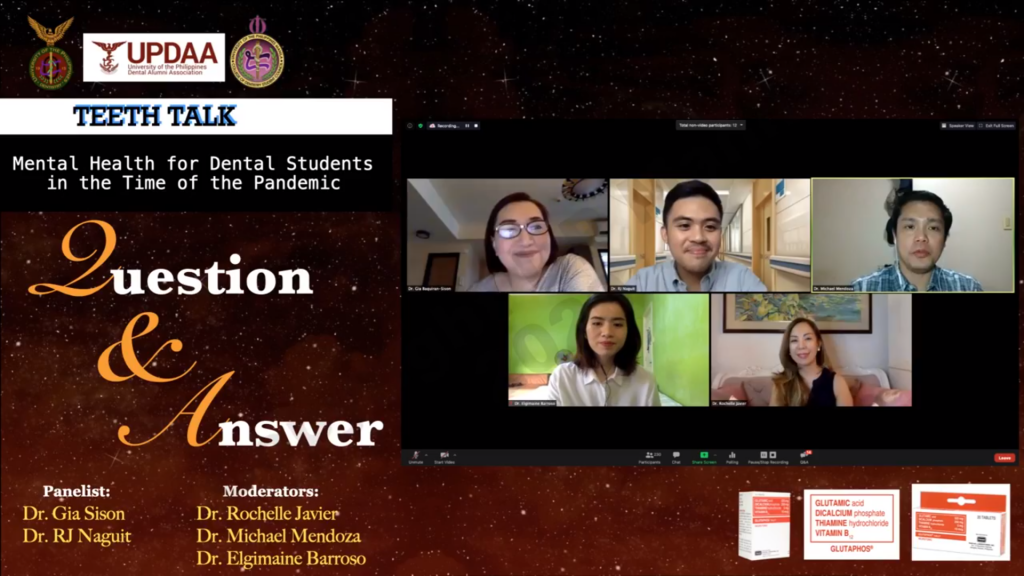
The University of the Philippines Dental Association and the University of the Philippines College of Dentistry (UPCD) with the University of the Philippines Manila Dentistry Student Council organized the webinar “Teeth Talk: Mental Health for Dental Students in the Time of the Pandemic” with mental health advocate Dr. Gia B. Sison as speaker last 09 June 2020.
Chancellor Carmencita D. Padilla welcomed the dental students not only from UPCD but also students from 21 other dental schools. Dr. Padilla recognized the anxiety everybody was feeling and challenged all participants to rise up and reach their potential as compassionate dentists of tomorrow.
Dr. Sison advised us to acknowledge all our emotions during this unprecedented time to be able to get over these vulnerabilities. She shared what she called “Tips” and not hard and fast rules as many of the concerns raised by the dental students in an earlier survey pertained to uncertainty and anxiety. The pandemic generated many concerns: feelings of uncertainty over the future; dealing with the loss of lives/death of loved ones; adjustment to the changes; barriers to accessing services; heightened emotions, followed by anxiety and loss of sleep; and additional threats of isolation and loneliness.
The following were the tips shared by Dr. Sison based on the principle that “coping is individualized and each one does it in different ways”:
• Gratitude does not mean letting go of a stressful situation; it is seeing something hopeful in time of uncertainty.
• Maintaining a daily routine of activities. Set a schedule and plan a variety of activities for the day.
• Maintaining social connection. Shift to online social activities; make brief, frequent interactions; make a phone call or a social media platform to connect with family and friends; create a support group where you can talk about not just dentistry but something you love doing that will make you engrossed and let you unburden.
• Limiting exposure to triggering content. Be mindful of the time spent on social media; limit exposure to social media if already distressing; have a regular and alloted time for social media.
• Provide practical help. Engage in activities that will help you and others, e.g. join volunteer groups providing food or supplies to frontliners; volunteer in doing errands.
• Reflect on existing coping strategies. Examine how you can address barriers to self-care; reduce or eliminate negative coping strategies and replace with positive practices.
• Practice sleep hygiene to boost immune system. Limit daytime naps to 30 mins; avoid stimulants such as caffeine and nicotine close to bedtime; establish a regular and relaxing bedtime routine and environment.
During the open forum, Dr. Sison was joined by Dr. RJ Naguit, founder and chair of Youth for Mental Health Coalition, as panelist in responding to the queries of faculty and students.
Among other things, the importance of a community support and a referral and feedback system was emphasized to address the mental health issues facing the students. Both panelists explained the need for clear plans and communicating these to all sectors involved including the parents who will set the tone at home; and flexibility in the learning methods and evaluation of learning to be used. Regular consultations with them boils down to participatory mechanisms and open feedback.
On symptoms that will require professional help, it was stressed that even with day-to-day concerns, a person can reach out to a guidance counsellor; and this will be more cost effective than waiting for the mental health problem to worsen. Below are clues that one may be in need of encouragement or professional help:
1. Dysfunction. Is your function already affected? Nakaka-trabaho ka ba pa o nakaka-function sa school? Are your relationships okay?
2. Deviance. How does your behavior compare with other people? Is your reaction to a stressful situation almost the same as how others would react to it? If not, it may be time to seek additional professional help.
3. Distress. Do your dysfunction and deviance cause an internal distress on your part?
4. Danger. Does it pose a danger to oneself (self-harm) or are you at risk of being violent to other people? If so, you need to be referred immediately to a professional.
5. Duration. Usually, with symptoms of long duration, the actions are probably not normal reactions to a stimulus anymore.
This activity had more than 300 attendees via Zoom and about 600 participants on FB Live through the UPCD Facebook Page and various Watch Parties. So far, this has been shared 150 times and viewed 9,200 times.
Dr. Michael Antonio F. Mendoza with Cynthia Villamor
Published in Healthscape Special COVID-19 Issue No. 9