


Text by Charmaine A. Lingdas
Photos by Joseph Bautista
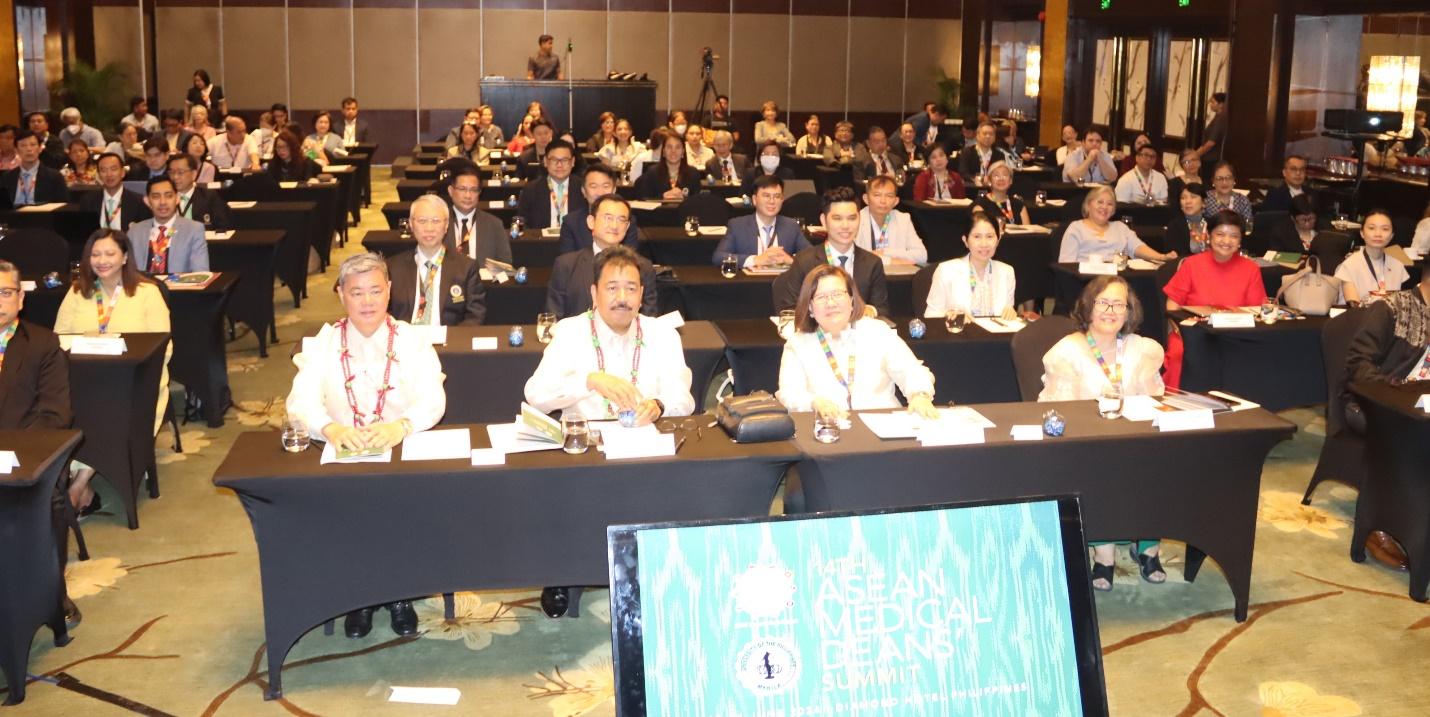
From left: Dr. Michael L. Tee, UP Manila Chancellor; Commissioner Prospero De Vera III, Commission on Higher Education (CHED); Dr. Charlotte M. Chiong, UPCM Dean and President of the ASEAN Medical Schools Network (AMSN); and Dr. Coralie Therese D. Dimacali, Overall Chair of AMDS 2024 and Associate Dean for Academic Development, UPCM, together with participants of the 14th ASEAN Medical Deans’ Summit
The University of the Philippines College of Medicine (UPCM) hosted the 14th ASEAN Medical Deans’ Summit from June 12-14, 2024, at the Diamond Hotel Manila, under the theme “Revolutionizing Medical Education for the Next Generation.” The summit aimed to foster collaboration among leading medical schools in the ASEAN region to advance medical education and address evolving health needs.
“This summit is a platform for important conversations about our priorities as medical schools,” stated Dr. Charlotte M. Chiong, UPCM Dean and President of the ASEAN Medical Schools Network (AMSN).
Dean Chiong said the summit would result in “shared frameworks, policies, programs, and practices that will harmonize ASEAN medical school curricula and revolutionize medical education for the next generation.”
She also emphasized the need for future medical school leaders, urging swift progress in transforming medical education. Reflecting on the lessons from the pandemic, she highlighted the importance of training doctors who are “compassionate, competent, capable of leading, conducting research, and making impactful contributions to their communities.” These doctors should have a global perspective while remaining responsive to local needs, promoting universal health care, and upholding health equity principles.
Key topics included simulation-based medical education, faculty recruitment and retention, social accountability in medical education, curriculum harmonization, and research collaboration.
Commissioner Prospero De Vera III of the Commission on Higher Education (CHED) underscored the necessity to apply lessons learned about health system structures during the pandemic to better prepare for future challenges. He also stressed that “we must continuously benchmark our medical education with what is happening in the rest of the [ASEAN] region.”
“I ask that in your discussions, you leverage the collective expertise and resources of your member institutions. We share a journey toward creating a future where access to quality health care is a universal right, enjoyed by all individuals. By adopting this perspective, medical school networks like the AMSN can help cultivate medical leaders who are not only clinically proficient but also attuned to the socio-economic realities of their regions,” asserted Commissioner De Vera.
He also implored medical schools to support each other in utilizing simulation-based education, emphasizing that the rapid advancements in medical technology necessitate adaptability and foster greater collaboration between institutions.
“With this summit, we will understand each other better, learn the socio-cultural background of each other and how it shapes the way we teach medicine, and find common grounds so that we can strengthen our health systems. Our health education will be able to address issues and enhance the way we share knowledge freely,” stated UP Manila Chancellor Michael L. Tee.
He also showcased UP Manila’s proactive role in evaluating CHED memorandum orders and enhancing educational guidelines in the Philippines. He mentioned new programs such as the MD-Master of Public Health and MD-PhD, designed to shape students who can generate new knowledge and develop cures for societal needs. He announced a new double degree program, the MD-Master of Science in Clinical Epidemiology, aimed at equipping students to analyze and respond effectively to pandemics.
Dr. Maria Julieta V. Germar from the University of the Philippines Manila highlighted the benefits of simulation-based education during the first plenary session, titled “Transformative Medical Education Using Simulation-Based Training, providing a controlled environment for learners to practice skills safely. Dr. Natdanai Mankasetkit from Mahidol University in Thailand noted that simulation primarily benefits faculty by creating realistic training scenarios. Dr. Yoyo Suhoyo from Universitas Gadjah Mada in Indonesia emphasized the importance of interdisciplinary education in preparing students for real-world healthcare environments.
During Plenary Session 2, titled “Recruitment, Retention, and Revitalization of the Faculty,” Dr. Agnes L. Soriano-Estrella from the University of the Philippines Manila underscored the importance of faculty development programs. Assoc. Prof. Dr. Vuong Thi Ngoc Lan from Ho Chi Minh City Medicine and Pharmacy University in Vietnam discussed strategies to address faculty retention, including incentives for publications and professional growth opportunities. Professor Dato’ Dr. Yang Faridah Abdul Aziz from Universiti Malaya in Malaysia highlighted the need for effective leadership and management to foster positive organizational behavior.
In the third plenary session that tackled “Evaluation Strategies and Controversies,” Dr. Ma Isabel Maniego Atienza from San Beda University College of Medicine stressed the need for effective assessment practices integrated into the learning process. Dr. Korakrit Imwattana from Mahidol University in Thailand advocated for continuous assessments to reduce stress and provide detailed feedback to students. Professor Dwiana Ocviyanti from Universitas Indonesia emphasized fair and comprehensive assessments for all medical students.
Dr. Anthony Geronimo H. Cordero from the University of the Philippines Manila highlighted the role of community engagement in medical education, integrating social accountability into the curriculum in the fourth Plenary Session titled “Social Accountability of Medical Education.” Dean Ari Fahrial Siam from Universitas Indonesia discussed the dual approach of residency programs based at both universities and hospitals. Professor Jason Kai Wei Lee from the National University Singapore addressed the impact of climate change on human health and innovative approaches to mitigate its effects.
The summit also featured sets of simultaneous sessions covering a wide range of topics: Session 1 on simulation strategies, facilitated by Prof. Dr. Dr. Dwiana Ocviyanti; Session 2 on faculty development, facilitated by Dr. Lee Shuh Shing; Session 3 on evaluation tools, facilitated by Dr. Melflor Atienza; Session 4 on social accountability evaluation, facilitated by Dr. Gene A. Nisperos; Session 5 on adapting digital technology, facilitated by Dr. Raymond Sarmiento; Session 6 on the challenges of the Next Gen (Z), facilitated by Dr. Nguyen Ngoc Thanh Tu; Session 7 on curriculum harmonization, facilitated by Prof. Lau Tang Ching; and Session 8 on research collaboration, facilitated by Dr. Marissa Alejandria.
The ASEAN Medical Schools Network (AMSN), formed in 2012, fosters cooperation among leading medical schools in ASEAN countries. It aims to enhance medical education and healthcare standards, share resources, build capacity, and promote unity within the ASEAN Economic Community. The ASEAN Medical Deans’ Summit (AMDS) gathers leaders from 10 ASEAN nations to discuss collective visions and collaboration, benefiting the region’s 600 million people. Annual summits, adapting to global circumstances such as the COVID-19 pandemic with virtual meetings, resumed in person in Laos in 2022 and continued in Malaysia in 2023.