

Text by: Angelou C. Mendoza
Photos by: Joseph A. Bautista

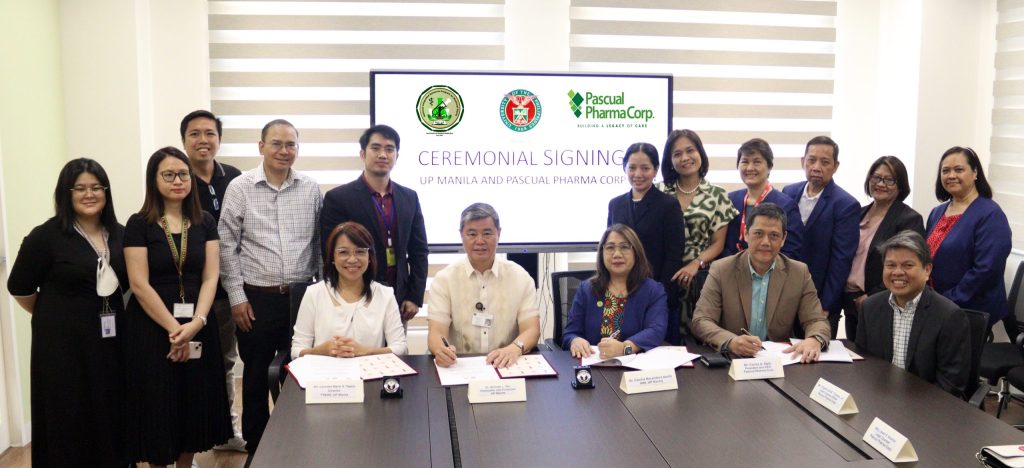
The University of the Philippines Manila (UPM) and Pascual Pharma Corp. (PPC) pushed for a renewed collaboration to license Sambong products as a diuretic and medication for hyperuricemia.
“We have a long history with Pascual Pharma. We’ve also collaborated on several events and you’ve supported us also in our advocacy. On our part, we have not stopped working on Sambong. We are still looking for other indications for Sambong and you might be surprised in the future. So this is our promise to you that we will continue to strive to make our products better and to advocate for all the stakeholders of herbal medicine,” Dr. Cecilia Maramba-Lazarte, Institute of Herbal Medicine (IHM) Director said in her statement during the ceremonial signing of the license agreement of the Sambong products on April 19, 2024 at the Henry Sy Sr. Hall, UP Manila.
Sambong (Blumea balsifera) is a traditionally used herbal medicine by Filipinos. In history, herbolarios were the first to utilize this herbal plant. Research on various medicinal plants abundant in the Philippines, including Sambong, started in the 1970s with the initiative of Dr. Nelia Maramba who was considered as the “Mother of Philippine Herbal Medicine” and recipient of various awards for her scientific discoveries and inventions.
IHM Director Cecilia Maramba-Lazarte spearheaded the licensing of two Sambong products, which were formulated and researched by the team at the UPM – National Integrated Research Program on Medicinal Plants (NIRPROMP), IHM.

PPC, headed by President Carlos A. Ople, became an official licensee of UP Manila through the legal assistance and support of the UPM Technology Transfer & Business Development Office (TTBDO) team led by Director Lourdes Marie S. Tejero.
The Sambong products in tablet form developed by IHM-NIRPROMP, are cost-effective with a 76% chance of decreasing the serum uric acid level of a patient diagnosed with hyperuricemia and with rare to no side effects, according to the team of Director Maramba-Lazarte.
During the ceremony, Chancellor Tee also underscored the economic aspect of the partnership. He mentioned that the collaboration would benefit farmers, as it is expected to increase the manufacturing demand for Sambong and other herbal medicine products, ultimately contributing to establishing sustainable communities.
“In addition to those present, the beneficiaries of this partnership extend beyond individuals with illnesses. There is also the community that makes sure the supply chain of Sambong is available – that’s the farming community,” Dr. Tee said. ■