


Text by Jennifer Manongdo and Angelou Mendoza
Photo by Erlyn Pareja
“You have achieved excellence, but are you relevant?” UP Manila Chancellor Michael L. Tee asked internists during the 5th Philippine Internal Medicine Summit on October 3-4,2024 at Pasay City.
Referencing a question once posed by National Scientist Ernesto O. Domingo in his message to medical experts at the University, Chancellor Tee encouraged internists to take a proactive stance in improving healthcare in the country by addressing the pressing crisis in human resources for health. Likewise, UP Manila, as the national health sciences center, must be a niche of healthcare professionals in the country willing to go beyond the enclave of medical settings and engage in the communities.
Chancellor Tee stressed that “true healthcare transformation begins in the community” echoing the message of Dr. Atul Gawande, USAID Assistant Administrator for Global Health during his visit to UP Manila in January.
“Our physician-to-population ratio in 2022 is a mere 3.6 doctors per 10,000 people when the ideal is 10 doctors per 10,0000,” added Chancellor Tee, who leads a team, working alongside the Commission on Higher Education (CHED), addressing the issue on the dwindling number of the country’s medical workforce. Citing figures from the Professional Regulation Commission (PRC), he said the lowest healthcare professional density is in the Bangsamoro Autonomous Region in Muslim Mindanao (BARMM) and Palawan or Region 4B, with two doctors per 10,000 people. Additionally, out of 159,283 registered doctors, only 95,039, or 59.70% are actively practicing their profession. Chancellor Tee stressed that “true healthcare transformation begins in the community” echoing the message of Dr. Atul Gawande, USAID Assistant Administrator for Global Health during his visit to UP Manila in January. The Philippines is on its way to becoming an upper-middle-income country. However, local health outcomes need to catch up to reflect a country with the said economic classification, Dr. Gawande said. The USAID official recommended improvements in the country’s primary healthcare system – the health centers and rural health units, to facilitate timely detection of diseases in the community, thus improving life expectancy in the country.
“As leaders in internal medicine, we are called to take a proactive stance in addressing pressing healthcare issues. We must advocate for policies that strengthen our healthcare infrastructure and ensure that our medical practice remains relevant and responsive to the needs of our people,” Chancellor Tee noted.
Risks, Challenges, and Benefits of Using AI in Healthcare
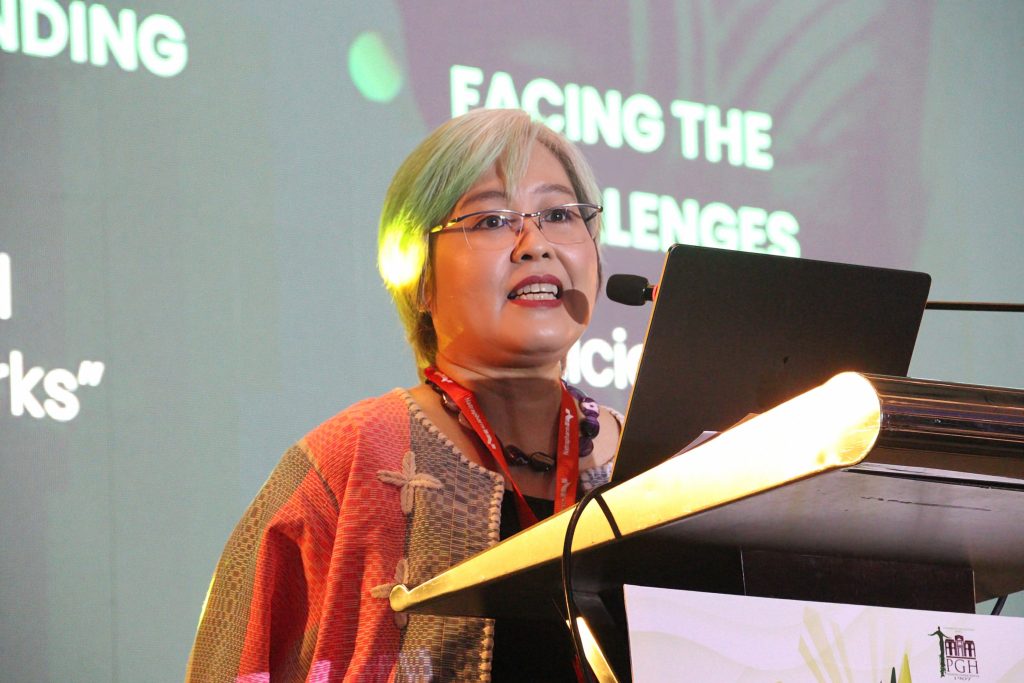
On the first day of the summit, Dr. Iris Thiele C. Isip-Tan, Chief of UP Medical Informatics Unit, discussed “Artificial Intelligence (AI) in Healthcare: Risks, Challenges, and Benefits.” The discussion focused on understanding the risks of using AI, the importance of clinicians and AI teams working together for safety, and the benefits of machine-learning early warning systems. Further discussion involved the World Health Organization (WHO) Consensus on Ethical Principles for the Use of AI for Health which aims to protect autonomy, foster responsibility and accountability, promote human well-being, human safety and the public interest, ensure inclusiveness and equity, ensure transparency, explainability, and intelligibility, and promote AI that is responsive and sustainable.
The two-day summit gathered experts from various medical societies who delved into timely discussions including the use of Artificial Intelligence (AI) in medicine, microbiome for atopic illnesses, personalized medicine in COPD, hepatitis B treatment, cancer treatment beyond chemotherapy, chronic diarrhea, septic arthritis, familial hypercholesterolemia, atypical diabetes, tropic pulmonary disease, pandemic update, angina, MASLD, periodic health examinations, ARDS, and blood transfusion therapy. Workshops on high-impact visual abstracts, ABG, reading X-rays and CT, ECG skills enhancement, interpretation of CBC and PBS results, and interpretation of frequently ordered infectious disease tests were also held. The 5th Philippine Internal Medicine Summit was organized by the University of the Philippines – Philippine General Hospital (UP-PGH) Department of Medicine.#